Mastering the DevSecOps Certified Professional Online Training Program
Introduction
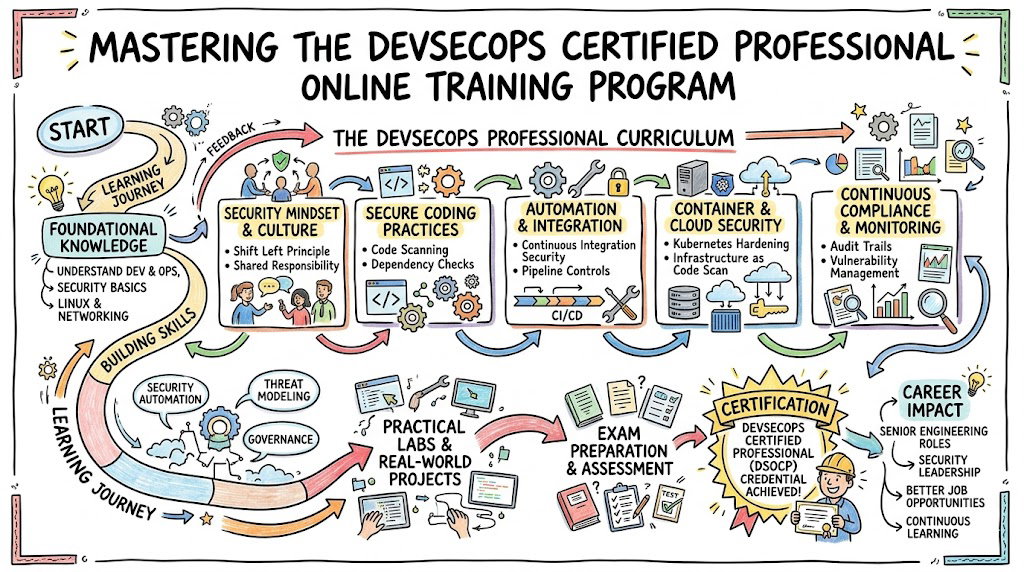
Securing the modern software delivery pipeline is no longer an optional task but a fundamental requirement for every engineering team. The DevSecOps Certified Professional Online Training provides a structured path for engineers to integrate security into every phase of the development lifecycle. This guide is designed for professionals looking to transition from traditional DevOps into specialized security-focused roles within cloud-native environments. By choosing to train with DevOpsSchool, participants gain the practical skills necessary to automate security audits and compliance. Consequently, this roadmap helps technical leaders make informed decisions about upskilling their workforce to meet global enterprise standards.
What is the DevSecOps Certified Professional Online Training?
The DevSecOps Certified Professional Online Training represents a shift from reactive security to proactive, automated protection. It exists to bridge the gap between rapid deployment and rigorous safety protocols in production-focused environments. Rather than focusing on abstract theory, this program emphasizes building a robust security culture within modern engineering workflows. It aligns with enterprise practices where security is treated as code, ensuring that every update is verified before it reaches the end-user.
Who Should Pursue DevSecOps Certified Professional Online Training?
Software engineers, SREs, and cloud architects who want to deepen their security expertise will find this training highly beneficial. It is equally relevant for security professionals who need to understand how to operate within a fast-paced CI/CD environment. Beginners looking for a clear entry point into the security domain and managers overseeing digital transformation projects will gain significant value. In the Indian and global markets, the demand for dually skilled DevOps and security experts is at an all-time high.
Why DevSecOps Certified Professional Online Training is Valuable in 2026 and Beyond
As cyber threats become more sophisticated, the demand for automated security measures continues to grow across all industries. This certification ensures longevity in a career because it focuses on core principles that remain relevant even as specific tools evolve. Organizations are rapidly adopting DevSecOps to reduce the risk of data breaches and to maintain compliance with international regulations. Investing time in this training offers a high return by making a professional indispensable to any high-scale enterprise.
DevSecOps Certified Professional Online Training Certification Overview
The program is delivered via the official course page and hosted on the main website. It utilizes a hands-on assessment approach that evaluates a candidate’s ability to implement security tools in real-world scenarios. The ownership of the curriculum lies with industry experts who ensure the structure remains practical and aligned with current market needs. Professionals will progress through various modules that cover everything from static analysis to container security and compliance monitoring.
DevSecOps Certified Professional Online Training Certification Tracks & Levels
The certification is structured into three distinct levels: foundation, professional, and advanced. The foundation level introduces core concepts, while the professional level focuses on deep technical implementation and automation. Advanced tracks are designed for those aiming for architect or leadership roles within the DevSecOps domain. These levels align with career progression, allowing an engineer to grow from a contributor to a strategic decision-maker.
Complete DevSecOps Certified Professional Online Training Certification Table
| Track | Level | Who it’s for | Prerequisites | Skills Covered | Recommended Order |
| Core Security | Foundation | Junior Engineers | Basic Linux | Security Principles | 1 |
| Engineering | Professional | DevOps Engineers | CI/CD Knowledge | Pipeline Security | 2 |
| Architecture | Advanced | Senior Architects | Pro Certification | Cloud Governance | 3 |
| Compliance | Specialist | Audit Managers | General IT | Automated Auditing | 4 |
Detailed Guide for Each DevSecOps Certified Professional Online Training Certification
DevSecOps Certified Professional Online Training – Foundation
What it isThis certification validates a candidate's understanding of the basic shift-left philosophy and security terminology. It ensures the professional understands how security integrates with the DevOps cycle.Who should take itAspiring security engineers and developers who are new to the concept of automated security should start here. It is ideal for those with less than two years of experience.Skills you’ll gain
- Understanding of the CIA triad in DevOps.
- Basic knowledge of vulnerability scanning.
- Familiarity with secure coding practices.
Real-world projects you should be able to do
- Perform a basic manual security audit on a small application.
- Identify common security flaws in a Dockerfile.
Preparation planA 7-day plan involves reviewing the core syllabus and terminology. A 30-day plan allows for introductory labs on security tools. A 60-day plan is best for those completely new to security concepts.Common mistakesFocusing only on tools rather than understanding the underlying security mindset. Neglecting the importance of communication between dev and security teams.Best next certification after this
- Same-track option: Professional DevSecOps Engineer.
- Cross-track option: SRE Certified Associate.
- Leadership option: Team Lead - Security Operations.
DevSecOps Certified Professional Online Training – Professional
What it isThis level confirms that an engineer can successfully automate security within a Jenkins or GitLab pipeline. It proves the ability to handle secrets management and container scanning at scale.Who should take itIntermediate DevOps engineers and security analysts who want to lead the implementation of security automation. Candidates should have a working knowledge of cloud platforms.Skills you’ll gain
- Implementation of SAST and DAST tools.
- Secrets management using tools like HashiCorp Vault.
- Automated compliance checks for cloud infrastructure.
Real-world projects you should be able to do
- Build a full CI/CD pipeline that breaks builds on high-priority security risks.
- Configure a centralized secrets management system for a microservices cluster.
Preparation planA 14-day intensive involves focusing on specific tool integrations. A 30-day plan should include building three distinct security pipelines. A 60-day plan is recommended for deep mastery of compliance-as-code.Common mistakesOver-complicating the pipeline to the point where it slows down development significantly. Failing to tune tools properly, leading to an excess of false positives.Best next certification after this
- Same-track option: DevSecOps Architect.
- Cross-track option: Advanced Cloud Security.
- Leadership option: DevSecOps Manager.
Choose Your Learning Path
DevOps Path
The DevOps path focuses on the seamless integration of development and operations with a heavy emphasis on speed. Professionals on this path learn to manage infrastructure as code and maintain high availability. It is the foundational journey for anyone looking to enter the world of modern software delivery.
DevSecOps Path
This path prioritizes the "security as code" movement by embedding checks into every stage of the pipeline. It requires a balance between engineering efficiency and risk management. Those on this path become the bridge between the development teams and the corporate security office.
SRE Path
Site Reliability Engineering focuses on the health, latency, and performance of production systems. It treats operations as a software problem and uses automation to ensure system resilience. This path is ideal for those who enjoy troubleshooting and optimizing high-traffic environments.
AIOps / MLOps Path
This specialized track applies artificial intelligence and machine learning to IT operations and model deployment. It involves managing the lifecycle of data models and using AI to predict system failures before they occur. It is perfect for engineers interested in the intersection of data science and infrastructure.
DataOps Path
DataOps is focused on improving the quality and cycle time of data analytics. It applies DevOps principles to data pipelines to ensure that information is accurate and accessible. This path is critical for organizations that rely heavily on big data for decision-making.
FinOps Path
FinOps brings financial accountability to the variable spend model of the cloud. It involves optimizing cloud costs while ensuring that engineering teams have the resources they need. Professionals on this track focus on the economic efficiency of the cloud infrastructure.
Role → Recommended DevSecOps Certified Professional Online Training Certifications
| Role | Recommended Certifications |
| DevOps Engineer | DevSecOps Professional, SRE Foundation |
| SRE | SRE Advanced, DevSecOps Foundation |
| Platform Engineer | Cloud Architect, DevSecOps Professional |
| Cloud Engineer | Cloud Security Specialist, DevSecOps Foundation |
| Security Engineer | DevSecOps Architect, Advanced Penetration Testing |
| Data Engineer | DataOps Certified, DevSecOps Foundation |
| FinOps Practitioner | FinOps Certified, Cloud Economics |
| Engineering Manager | DevSecOps Leadership, Agile Management |
Next Certifications to Take After DevSecOps Certified Professional Online Training
Same Track Progression
Deep specialization within the security domain involves moving toward architectural roles. This means focusing on enterprise-wide security governance and high-level strategy. It ensures that the professional can design systems that are secure by default at a massive scale.
Cross-Track Expansion
Broadening your skills into SRE or FinOps provides a more holistic view of the engineering ecosystem. By understanding reliability or cost management, a security professional becomes more valuable to the business. This cross-pollination of skills is what defines a principal-level engineer.
Leadership & Management Track
Transitioning into leadership requires a shift from technical execution to team empowerment and strategy. This track focuses on budgeting, hiring, and aligning security goals with business objectives. It prepares professionals to lead entire departments or become Chief Information Security Officers.
Training & Certification Support Providers for DevSecOps Certified Professional Online Training
DevOpsSchoolThis provider offers extensive resources and expert-led sessions tailored for the global engineering community. They focus on practical labs that simulate real production environments, ensuring that students can apply what they learn immediately. Their curriculum is updated frequently to reflect the latest changes in the security landscape.CotocusThis organization specializes in high-end technical consulting and training for enterprise-level teams. They provide deep dives into niche technologies and offer customized learning paths for large organizations. Their approach is highly professional and geared toward senior engineers.ScmgalaxyA community-driven platform that provides a wealth of tutorials, blogs, and technical documentation. It serves as a hub for professionals to share knowledge and stay updated on the latest DevOps tools. Their content is known for being accessible and highly detailed.BestDevOpsThis provider focuses on curated learning experiences that highlight the most effective tools in the market. They offer a streamlined approach to certification, helping professionals achieve their goals efficiently. Their training modules are designed to be concise and impactful.devsecopsschool.comA dedicated portal for security-focused training that covers everything from basics to advanced automation. They emphasize the cultural shift required for successful security integration. Their trainers are active practitioners in the field of cybersecurity.sreschool.comThis site provides specialized training for those looking to master site reliability engineering. The focus is on observability, incident management, and system resilience. It is an essential resource for engineers who want to manage large-scale cloud infrastructure.aiopsschool.comFocused on the future of operations, this provider teaches how to use machine learning to manage IT systems. They cover data processing, predictive analytics, and automated remediation. This is the go-to site for engineers interested in AI-driven infrastructure.dataopsschool.comThis platform addresses the unique challenges of managing data pipelines in a DevOps environment. They provide training on data quality, orchestration, and lifecycle management. It is a vital resource for data engineers and analysts.finopsschool.comSpecializing in cloud financial management, this provider teaches engineers how to control cloud spending. They offer practical strategies for cost optimization and resource allocation. Their training helps bridge the gap between finance and engineering teams.
Frequently Asked Questions
- How difficult is the DevSecOps professional assessment?The assessment is moderately challenging as it requires both theoretical knowledge and practical tool implementation skills.
- How much time should I dedicate to training each day?Consistency is key, so spending one to two hours daily is generally more effective than long weekend sessions.
- Are there any specific prerequisites for the professional level?A solid understanding of Linux and basic CI/CD pipeline concepts is highly recommended before starting.
- What is the return on investment for this certification?Professionals often see significant salary increases and access to more senior roles after completing this training.
- Should I take the SRE training before or after DevSecOps?It depends on your career goals, but many find that understanding security first provides a better foundation for reliability.
- Is this training suitable for project managers?Yes, it provides managers with the technical context needed to lead security-conscious engineering teams.
- How long does the certification remain valid?Most industry-standard certifications recommend a refresher every two to three years to stay current with new technologies.
- Can I complete this training while working a full-time job?The program is designed to be flexible, allowing working professionals to learn at their own pace.
- What tools will I learn during the course?You will typically work with tools for container security, static and dynamic analysis, and secrets management.
- Is there a community or forum for students?Most providers offer access to a private group or forum where students can collaborate and ask questions.
- Does the training cover cloud-specific security?Yes, it generally includes security practices for major cloud providers like AWS, Azure, and Google Cloud.
- Are the labs hosted on a cloud platform?Most high-quality training providers offer cloud-based lab environments for hands-on practice.
FAQs on DevSecOps Certified Professional Online Training
- What makes this training different from a general security course?This training specifically focuses on the automation and integration aspects of security within the DevOps lifecycle.
- Is coding required for this certification?A basic ability to read and edit scripts or configuration files is necessary for the practical portions of the course.
- How does this help with compliance audits?It teaches you how to automate the evidence-gathering process, making audits much faster and more accurate.
- Can I take the exam online?Yes, the certification process is typically handled through an online proctored environment for global accessibility.
- Will I learn about Kubernetes security?Container orchestration security is a major component of the professional and advanced levels of this training.
- Is there support for job placement after certification?Many providers offer career guidance and connections to a network of hiring partners in the tech industry.
- What if I fail the initial assessment?Most programs offer a retake option after a short cooling-off period to allow for additional study.
- Are the training materials downloadable?While the videos are usually streamed, many providers allow you to download scripts, checklists, and PDF guides.
Final Thoughts: Is DevSecOps Certified Professional Online Training Worth It?
If you are looking to stay relevant in an industry that is increasingly obsessed with security and speed, this training is a vital investment. It moves you beyond being a generalist and positions you as a specialist in a high-demand field. The practical skills gained are immediately applicable to production environments, which is exactly what modern employers are looking for. While it requires a commitment of time and effort, the career stability and growth opportunities it provides are substantial. As a mentor, I recommend this path for anyone who wants to be at the forefront of engineering excellence.
