Complete Guide to Certified DevOps Professional
Introduction
Navigating the modern cloud-native landscape requires more than just knowing how to script; it demands a holistic understanding of the entire software delivery lifecycle. The Certified DevOps Professional designation serves as a rigorous benchmark for engineers who want to validate their expertise in automation, orchestration, and culture. This guide is specifically crafted for software engineers and technical leaders at DevOpsSchool who are looking to move beyond basic tool knowledge into architectural mastery. By reading this, you will gain a clear roadmap for your professional development, helping you choose the right specializations to future-proof your career in a competitive global market.
What is the Certified DevOps Professional?
The Certified DevOps Professional represents a high-standard validation of an engineer's ability to design and manage complex, production-ready infrastructures. Unlike entry-level certificates that focus on memorizing command-line interface syntax, this program emphasizes the integration of disparate tools into a cohesive ecosystem. It exists to bridge the gap between theoretical cloud concepts and the messy reality of enterprise-scale deployments. Consequently, it aligns perfectly with modern engineering workflows, ensuring that practitioners can handle the speed and reliability requirements of today’s digital businesses.
Who Should Pursue Certified DevOps Professional?
This certification is highly beneficial for Site Reliability Engineers (SREs), systems administrators, and full-stack developers who are responsible for the "run" phase of software. It is equally relevant for beginners who need a structured learning path and experienced veterans who want to formalize their years of "on-the-job" learning. Engineering managers find value here as well, as it provides them with the technical vocabulary needed to lead high-performing teams effectively. In both the Indian tech hubs and the global silicon markets, having this credential signals a commitment to industry best practices and operational excellence.
Why Certified DevOps Professional is Valuable in 2026 and Beyond
As organizations continue to migrate to multi-cloud environments, the demand for standardized DevOps practices is only increasing. The Certified DevOps Professional ensures that your skills remain durable even as specific tools come and go, because it focuses on the underlying principles of CI/CD, observability, and infrastructure as code. This longevity provides a significant return on your time investment, making you a versatile asset for any enterprise adopting cloud-native technologies. Ultimately, it protects your career against automation by positioning you as the architect of the systems that perform the automation.
Certified DevOps Professional Certification Overview
The program is delivered via the official course page and is hosted on the DevOpsSchool platform. It is structured as a comprehensive curriculum that balances instructor-led insights with intensive hands-on labs to simulate real-world outages and deployments. The assessment approach is designed to test practical problem-solving skills rather than rote memorization of definitions. By maintaining a strict ownership of the curriculum, the hosting site ensures that the content is updated frequently to reflect the latest shifts in the CNCF landscape and enterprise security requirements.
Certified DevOps Professional Certification Tracks & Levels
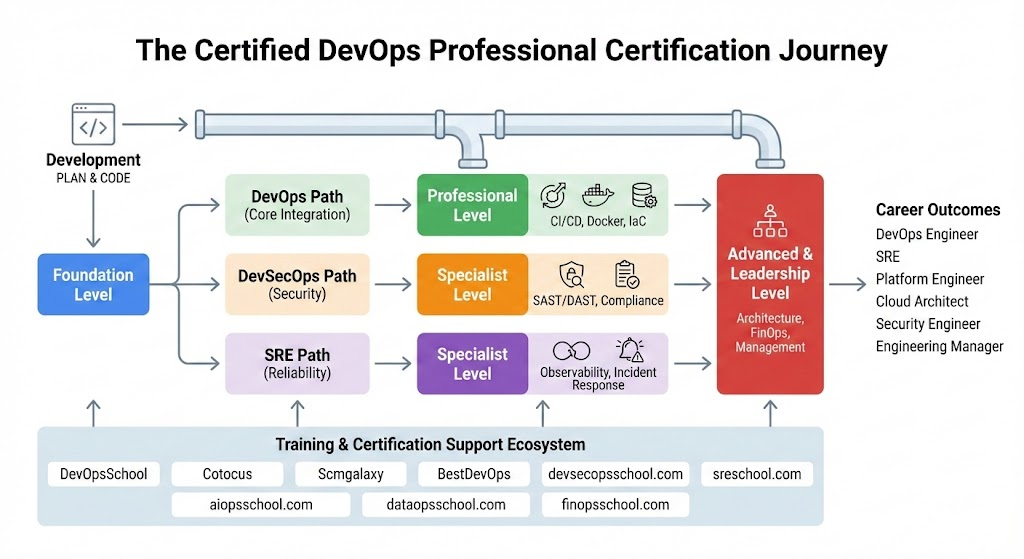
The certification is organized into three distinct tiers: Foundation, Professional, and Advanced, allowing for a natural career progression. The Foundation level focuses on core cultural values and basic automation, while the Professional level dives deep into container orchestration and cloud-native architecture. For those looking to specialize further, the Advanced tracks offer deep dives into niche areas like FinOps for cost optimization or DevSecOps for integrated security. This tiered structure ensures that an engineer can start at any point in their journey and find a path that aligns with their specific professional goals.
Complete Certified DevOps Professional Certification Table
| Track | Level | Who it’s for | Prerequisites | Skills Covered | Recommended Order |
| Core DevOps | Foundation | Junior Engineers | Basic Linux / Git | CI/CD, Culture, Basics | 1 |
| Engineering | Professional | Mid-level SREs | Foundation Cert | K8s, Terraform, Jenkins | 2 |
| Security | Advanced | Security Analysts | Professional Cert | Shift Left, Vault, SAST | 3 |
| Operations | Advanced | SREs / Ops Leads | Professional Cert | Monitoring, SLOs, SLIs | 3 |
| Management | Professional | Leads / Managers | Basic SDLC | Metrics, ROI, Team Flow | 2 |
Detailed Guide for Each Certified DevOps Professional Certification
Certified DevOps Professional – Foundation Level
What it isThis certification validates a candidate's fundamental understanding of the DevOps movement, its history, and the core pillars of the CAMS model (Culture, Automation, Measurement, Sharing).Who should take itIt is ideal for fresh graduates, project managers, or traditional QA engineers who are transitioning into a DevOps-centric environment and need to understand the big picture.Skills you’ll gain
- Mastery of Git-based version control workflows.
- Understanding of continuous integration concepts.
- Knowledge of various automation tool categories.
- Ability to collaborate across siloed departments.
Real-world projects you should be able to do
- Set up a basic automated build pipeline for a web app.
- Implement a branching strategy for a small development team.
Preparation plan
- 7–14 days: Focus on terminology, the Agile manifesto, and basic Git commands.
- 30 days: Complete the lab exercises for building a simple CI pipeline.
- 60 days: Engage in community forums and review case studies of DevOps transformations.
Common mistakes
- Skipping the cultural aspect to focus only on tools.
- Overlooking the importance of documentation in the automation process.
Best next certification after this
- Same-track option: Professional Level Certified DevOps Professional.
- Cross-track option: Foundation DevSecOps.
- Leadership option: DevOps Management Essentials.
Certified DevOps Professional – Professional Level
What it isThis certification confirms an engineer's proficiency in deploying, managing, and scaling containerized applications within a cloud-native ecosystem using industry-standard tools.Who should take itSuitable for developers or sysadmins with at least one year of experience who are now responsible for maintaining production environments and deployment pipelines.Skills you’ll gain
- Advanced container orchestration using Kubernetes.
- Infrastructure as Code (IaC) with Terraform.
- Configuration management using Ansible.
- Deep mastery of Jenkins and GitLab CI.
Real-world projects you should be able to do
- Provision a multi-tier cloud infrastructure using IaC scripts.
- Deploy a microservices application to a Kubernetes cluster with zero downtime.
Preparation plan
- 7–14 days: Deep dive into Docker and container networking.
- 30 days: Practice writing complex Terraform modules and Ansible playbooks.
- 60 days: Build a full end-to-end pipeline including automated testing and deployment.
Common mistakes
- Ignoring security best practices in the pursuit of fast deployments.
- Relying too heavily on manual fixes instead of fixing the automation script.
Best next certification after this
- Same-track option: Advanced SRE Specialization.
- Cross-track option: Certified DataOps Professional.
- Leadership option: Engineering Manager Track.
Choose Your Learning Path
DevOps Path
The DevOps path focuses on the core cycle of building, testing, and releasing software with maximum efficiency. It is the primary route for those who enjoy creating seamless pipelines and reducing the friction between developers and operations. Professionals on this path spend their time optimizing build speeds and ensuring that the deployment process is boring and predictable. It serves as the foundation for almost every other specialized path in modern engineering.
DevSecOps Path
This path integrates security into every stage of the development lifecycle rather than treating it as an afterthought. You will learn how to automate security scanning, manage secrets, and ensure compliance without slowing down the delivery team. It is perfect for engineers who are passionate about protecting data and building resilient systems. As threats evolve, this path continues to see massive growth in enterprise demand.
SRE Path
Site Reliability Engineering focuses on applying software engineering principles to operations problems to create highly scalable and reliable software systems. On this path, you will learn about error budgets, service level objectives (SLOs), and incident response strategies. It is ideal for those who enjoy deep-market debugging and architectural scaling challenges. SREs are the guardians of uptime in the modern digital world.
AIOps / MLOps Path
This specialty addresses the unique challenges of deploying and maintaining artificial intelligence and machine learning models in production. You will focus on data versioning, model monitoring, and automated retraining pipelines to ensure accuracy over time. It is a bridge between the world of data science and traditional operations. As AI becomes ubiquitous, these skills are becoming essential for modern enterprises.
DataOps Path
DataOps is a collaborative data management practice focused on improving the communication and integration of data flows between data managers and consumers. This path teaches you how to apply DevOps principles to data pipelines to ensure high data quality and fast delivery. It is a vital role for organizations that rely on real-time analytics to make business decisions. You will work closely with data engineers and architects.
FinOps Path
FinOps is an evolving cloud financial management discipline that enables organizations to get maximum business value by helping engineering and finance teams collaborate. This path focuses on cloud cost optimization, budgeting, and resource tagging to ensure cloud spend is transparent and efficient. It is highly valued by leadership because it directly impacts the company’s bottom line. Professionals here bridge the gap between technical usage and financial accountability.
Role → Recommended Certified DevOps Professional Certifications
| Role | Recommended Certifications |
| DevOps Engineer | Professional Level + DevSecOps Advanced |
| SRE | Professional Level + SRE Advanced Specialization |
| Platform Engineer | Professional Level + Kubernetes Specialist |
| Cloud Engineer | Foundation + Multi-Cloud Professional |
| Security Engineer | Foundation + DevSecOps Advanced |
| Data Engineer | Foundation + DataOps Professional |
| FinOps Practitioner | Foundation + FinOps Specialization |
| Engineering Manager | Foundation + Management Track |
Next Certifications to Take After Certified DevOps Professional
Same Track Progression
Once you have achieved the professional designation, the logical next step is to pursue advanced specializations in niche areas like service mesh or eBPF. Deep specialization allows you to become the "go-to" expert for complex architectural problems that standard engineers cannot solve. This often leads to principal-level roles where you influence the technical direction of the entire company. Continuous learning in your core track ensures you remain at the cutting edge of technological shifts.
Cross-Track Expansion
For those who want to move into leadership or architecture, broadening your skills across different tracks is highly effective. An engineer who understands both DevOps and FinOps, for example, is uniquely qualified to lead a cloud transformation project. Cross-track expansion makes you a "T-shaped" professional with deep expertise in one area and broad knowledge across many. This versatility is often the key to moving into high-level consulting or senior management roles.
Leadership & Management Track
If your goal is to lead teams, you should transition toward certifications that focus on team dynamics, value stream mapping, and lean management. These programs teach you how to measure the success of a DevOps transformation using business-centric metrics rather than just technical ones. Transitioning to leadership requires a shift from "doing the work" to "enabling the team" to do their best work. It involves mastering the art of communication and strategic planning within a technical context.
Training & Certification Support Providers for Certified DevOps Professional
DevOpsSchool
This provider offers a comprehensive ecosystem for learners, including live instructor-led training and an extensive library of video resources. They focus heavily on the practical application of tools within real-world scenarios, making them a top choice for professionals.
Cotocus
This organization specializes in high-end consulting and corporate training, ensuring that the certification content is aligned with current enterprise requirements. Their trainers are often active consultants who bring fresh industry perspectives to the classroom.
Scmgalaxy
Known for its deep technical community and vast repository of tutorials, this provider is excellent for engineers who prefer a community-driven learning approach. They offer extensive support for mastering version control and configuration management tools.
BestDevOps
This platform focuses on curated learning paths that guide students from absolute basics to advanced architectural concepts. Their curriculum is highly structured, making it easy for busy professionals to fit certification prep into their schedules.
devsecopsschool.com
This specialized provider focuses exclusively on the intersection of security and operations. They offer deep-dive modules on container security, automated compliance, and secure software supply chains for those pursuing the security track.
sreschool.com
Dedicated to the principles of Site Reliability Engineering, this site provides advanced training on observability, incident management, and system resilience. It is the go-to resource for engineers aiming for high-availability roles.
aiopsschool.com
This provider addresses the emerging field of using artificial intelligence to enhance operations. Their courses cover machine learning for log analysis, predictive maintenance, and automated anomaly detection in large-scale systems.
dataopsschool.com
Focused on the data lifecycle, this provider teaches engineers how to apply DevOps rigor to data engineering. Their training covers data pipeline automation, quality testing, and integration with modern data warehouses.
finopsschool.com
This platform is the leader in cloud financial management training, helping professionals master the art of cloud cost optimization. They provide the tools and frameworks needed to align technical spend with business value.
Frequently Asked Questions (General)
- How difficult is the Certified DevOps Professional exam?
The exam is moderately difficult and requires a solid understanding of both theory and hands-on practice. - How much time do I need to prepare?
Most professionals spend between 30 to 60 days preparing, depending on their existing experience level. - Are there any prerequisites for the professional level?
While not mandatory, having a foundation-level understanding or equivalent industry experience is highly recommended. - What is the return on investment for this certification?
Certified professionals often see a significant increase in salary and are eligible for more senior roles in top tech firms. - Can I take the exam online?
Yes, the certification is designed to be accessible globally through a secure online proctoring system. - In what order should I take the certifications?
It is best to start with the Foundation, move to the Professional, and then choose a specialization track. - Does the certification expire?
The certification is valid for two years, after which you may need to renew it to ensure your skills are current. - Is this certification recognized globally?
Yes, it is highly respected by enterprises in India, the US, Europe, and beyond. - Are there labs included in the training?
Yes, the program includes extensive hands-on labs to ensure you can apply what you learn in production. - Do I need to know how to code?
A basic understanding of scripting (Python or Bash) is very helpful for the automation sections. - What tools are covered in the curriculum?
The course covers major tools like Git, Jenkins, Docker, Kubernetes, Terraform, and Ansible. - Is there post-certification support?
Many of the hosting providers offer community access and job placement assistance after you pass.
FAQs on Certified DevOps Professional
- How does this certification differ from tool-specific certificates?
This program focuses on the integration and workflow of the entire ecosystem rather than just one specific software. - Is it suitable for non-technical managers?
The Foundation level is perfect for managers, while the Professional level is more suited for hands-on engineers. - What is the passing score for the assessment?
Candidates typically need to score at least 70% to pass the final evaluation. - Are there real-world projects included?
Yes, the certification requires the completion of several capstone projects that mimic enterprise challenges. - How often is the course content updated?
The curriculum is reviewed quarterly to include new tools and updated best practices from the CNCF. - Does it cover multi-cloud strategies?
Yes, the Professional level includes modules on deploying across AWS, Azure, and Google Cloud Platform. - Can I get a refund if I don't like the training?
Refund policies vary by provider, so it is important to check the terms on the official website. - Are there group discounts for corporate teams?
Most providers offer bulk pricing for organizations looking to certify their entire engineering department.
Final Thoughts: Is Certified DevOps Professional Worth It?
If you are looking for a way to stand out in a crowded job market, the Certified DevOps Professional is a solid investment. It doesn't just give you a badge; it forces you to think like an architect and understand the "why" behind the "how." As a mentor, I have seen many engineers use this credential as a springboard to move from junior roles into high-paying SRE and Lead positions. However, remember that the certificate is only as good as the work you put into the labs. Focus on the learning, build real things, and the career growth will follow naturally. It is a marathon, not a sprint, and this guide is your starting line.
