Mastering Enterprise Systems: The Ultimate Guide to Certified DevOps Architect
Introduction
Modern engineering environments demand a shift from simple task execution to high-level system design. Consequently, the Certified DevOps Architect role has emerged as a vital milestone for professionals who want to lead technical transformations. This guide empowers engineers to navigate the complexities of cloud-native ecosystems and infrastructure governance effectively. Furthermore, experts at DevOpsSchool utilize this program to bridge the gap between development speed and operational stability. By exploring the Certified DevOps Architect path, you gain the strategic insight necessary to build resilient, scalable software delivery pipelines.
What is the Certified DevOps Architect?
The Certified DevOps Architect represents a peak level of expertise in orchestrating the entire software development lifecycle. Instead of focusing on isolated tools, this role emphasizes the creation of cohesive, production-ready frameworks. This designation exists because modern enterprises require leaders who can synchronize automation, security, and scalability across diverse cloud environments. Additionally, the curriculum prioritizes practical, hands-on architectural patterns over abstract theory. As a result, architects learn to solve real-world bottlenecks that hinder rapid deployment and system reliability.
Who Should Pursue Certified DevOps Architect?
Senior engineers, system administrators, and cloud consultants who aspire to take on leadership roles should prioritize this certification. Moreover, Site Reliability Engineers and platform architects will find the curriculum directly applicable to their daily challenges. While the program welcomes ambitious learners, it specifically targets those with existing experience in automation and infrastructure management. Managers and technical leads in India and global markets also benefit significantly, as it provides a standardized framework for evaluating team capabilities. Consequently, it serves as a bridge for any technical professional moving toward a principal or lead role.
Why Certified DevOps Architect is Valuable Today and Beyond
Enterprise reliance on cloud-native technology continues to grow, making the architect's role more critical than ever. Furthermore, as organizations adopt multi-cloud and serverless strategies, they need experts who can design stable, cost-effective environments. This certification ensures that your skills remain relevant despite the rapid arrival of new tools and technologies. Since it focuses on foundational architectural principles, it offers a high return on investment for your career longevity. Ultimately, it positions you as a strategic asset capable of steering digital transformation initiatives with confidence.
Certified DevOps Architect Certification Overview
DevOpsSchool delivers this comprehensive program through a mix of deep-dive training and practical assessments. The program, hosted on the official Website, evaluates a candidate's ability to integrate security, performance, and reliability into every stage of the pipeline. Furthermore, the certification ownership ensures the content reflects current industry shifts toward AI-driven operations and high-velocity delivery. You will encounter a structured learning path that covers everything from initial design to long-term governance. Consequently, the assessment mirrors the actual pressures and decision-making processes found in top-tier engineering teams.
Certified DevOps Architect Certification Tracks & Levels
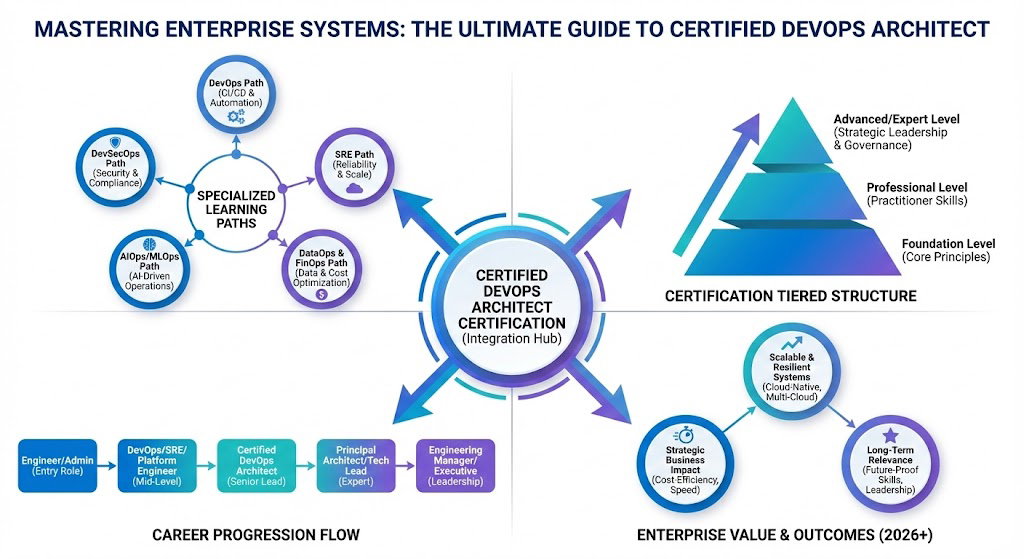
The certification features multiple tiers to support ongoing professional growth. It starts with foundation levels for those establishing their core skills and moves toward advanced tiers for enterprise thought leaders. Additionally, specialized tracks allow you to focus on specific domains such as SRE, DevSecOps, or FinOps. This hierarchical approach ensures that you can logically progress through your career while building a broad and deep technical repertoire. As you move up, the focus shifts from implementation details to high-level strategic governance and organizational scaling.
Complete Certified DevOps Architect Certification Table
| Track | Level | Who it’s for | Prerequisites | Skills Covered | Recommended Order |
| Core Frameworks | Foundation | Mid-level Engineers | Basic Cloud Knowledge | CI/CD, Scripting, Git | 1 |
| Advanced Systems | Professional | Senior DevOps Leads | 3+ Years Experience | Kubernetes, IaC, Scaling | 2 |
| Enterprise Strategy | Advanced | Principal Architects | 6+ Years Experience | Compliance, Governance | 3 |
| Future Operations | Expert | SREs & Tech Leaders | Advanced Certification | AIOps, MLOps, FinOps | 4 |
Detailed Guide for Each Certified DevOps Architect Certification
Certified DevOps Architect – Advanced Level
What it isThis certification validates your ability to lead large-scale digital transformations and manage complex multi-cloud environments. It proves you can design systems that balance extreme speed with ironclad reliability.Who should take itThis track suits principal engineers, technical directors, and seasoned architects who oversee multiple engineering teams. It is for those who move the needle on organizational strategy and technical excellence.Skills you’ll gain
- Mastery of Enterprise Kubernetes Orchestration
- Designing Multi-Region Disaster Recovery
- Implementing Global Security Standards
- Strategic Cost Optimization across Clouds
Real-world projects you should be able to do
- Leading a migration of a legacy monolithic system to a global microservices architecture.
- Designing an automated compliance engine that monitors thousands of cloud resources.
- Building a federated CI/CD platform for a multinational engineering organization.
Preparation plan
- 7–14 days: Review high-level design patterns and case studies of successful enterprise cloud migrations.
- 30 days: Deeply explore integration points between specialized security tools and core delivery pipelines.
- 60 days: Conduct extensive lab simulations focusing on scaling, failure recovery, and performance optimization at scale.
Common mistakes
- Over-engineering solutions for simple problems instead of choosing the most efficient path.
- Ignoring the human and cultural elements that drive successful DevOps adoption.
- Failing to account for long-term maintenance and technical debt during the design phase.
Best next certification after this
- Same-track option: Master DevOps Architect
- Cross-track option: Certified SRE Professional
- Leadership option: Executive Technology Leadership Program
Choose Your Learning Path
DevOps Path
The DevOps path focuses on the seamless flow of code from inception to production. Consequently, you learn to eliminate silos and automate every repetitive task in the software delivery chain. This track emphasizes speed, quality, and feedback loops, making it the most versatile choice for modern engineers. Furthermore, it builds the foundational mindset required for all other specialized tracks. It remains the most popular starting point for those entering the architectural domain.
DevSecOps Path
This path prioritizes security by integrating it into the earliest stages of development. Instead of treating security as a final gate, you learn to build automated checks directly into the CI/CD pipeline. Additionally, you gain expertise in vulnerability management, identity protection, and compliance as code. This track is essential for architects working in finance, government, or healthcare sectors. Consequently, it creates a "security-first" culture that protects the organization without slowing down delivery.
SRE Path
The Site Reliability Engineering path concentrates on the stability and availability of systems in production. You learn to use software engineering principles to solve operational problems, such as managing error budgets and service level objectives. Furthermore, this track teaches you how to design self-healing systems that can survive major outages. It is ideal for architects who value "Day 2" operations as much as the initial deployment. As a result, you become an expert in building systems that users can trust around the clock.
AIOps / MLOps Path
This forward-looking path combines artificial intelligence with traditional operations to drive efficiency. You will explore how to use machine learning to predict system failures and automate complex incident responses. Moreover, you learn to manage the unique lifecycle of machine learning models, from training to deployment. This is a critical skill set as enterprises increasingly rely on data-driven decision-making. Consequently, it prepares you to handle the massive data volumes and processing needs of the future.
DataOps Path
The DataOps path applies the principles of agility and automation to data management and analytics. You learn to streamline the flow of data between sources, storage, and consumers while ensuring high quality and security. Furthermore, this track focuses on reducing the cycle time of data insights, which directly impacts business agility. It is the perfect choice for architects working closely with data scientists and business intelligence units. As a result, you ensure that data remains a reliable asset for the entire organization.
FinOps Path
The FinOps path brings financial discipline to the world of cloud infrastructure. You learn how to track, manage, and optimize cloud spending to ensure every resource provides maximum value. Additionally, this track teaches you how to bridge the gap between engineering teams and finance departments. This is vital for any organization scaling its cloud footprint rapidly. Consequently, you become the person who ensures technical innovation remains fiscally sustainable.
Role → Recommended Certified DevOps Architect Certifications
| Role | Recommended Certifications |
| DevOps Engineer | Certified DevOps Architect - Core Track |
| SRE | Certified DevOps Architect - SRE & Reliability |
| Platform Engineer | Certified DevOps Architect - Advanced Systems |
| Cloud Engineer | Certified DevOps Architect - Multi-Cloud Specialist |
| Security Engineer | Certified DevOps Architect - DevSecOps Track |
| Data Engineer | Certified DevOps Architect - DataOps Track |
| FinOps Practitioner | Certified DevOps Architect - FinOps Track |
| Engineering Manager | Certified DevOps Architect - Enterprise Strategy |
Next Certifications to Take After Certified DevOps Architect
Same Track Progression
Once you master the professional architect level, you should pursue "Master" or "Fellow" designations. These advanced programs focus on the highest levels of technical leadership and cross-organizational influence. Furthermore, they prepare you to set the technical vision for entire companies. Deepening your expertise in this way ensures you stay at the forefront of the industry. It also opens doors to the most prestigious roles in the engineering world.
Cross-Track Expansion
Broadening your skills into areas like cybersecurity or big data provides a massive competitive advantage. Furthermore, having a diverse skill set allows you to solve multifaceted problems that single-domain experts might miss. This "T-shaped" approach makes you an invaluable leader who can communicate across different technical departments effectively. Consequently, you become more resilient to market shifts and technology changes. Skill broadening is the best way to ensure long-term career growth.
Leadership & Management Track
If you enjoy mentoring teams and driving business outcomes, transition toward management certifications. These programs teach you how to handle budgets, develop talent, and align technology with corporate goals. Moreover, they help you translate technical architectural wins into business value that executives understand. This path is essential for those who want to move into Director or VP-level roles. Ultimately, it allows you to influence the organization on a much larger scale.
Training & Certification Support Providers for Certified DevOps Architect
DevOpsSchool
DevOpsSchool provides world-class training that emphasizes practical labs and mentor-led sessions. Their instructors bring decades of real-world experience to the classroom, ensuring you learn what actually works in production. Furthermore, they offer a vast library of resources that support your learning long after the course ends. Students consistently praise their hands-on approach and commitment to student success. They remain a top choice for those seeking a comprehensive architectural education.
Cotocus
Cotocus focuses on high-end technical consulting and specialized training for cloud-native technologies. They provide intensive bootcamps that help senior engineers master Kubernetes and advanced infrastructure as code. Moreover, their curriculum is designed for those who want to push the boundaries of modern engineering. They offer a highly technical environment that challenges even the most seasoned professionals. It is a perfect fit for anyone looking for a rigorous, code-centric learning experience.
Scmgalaxy
Scmgalaxy serves as a massive community hub and training platform for software configuration management and DevOps. They provide a unique blend of community-driven knowledge and formal certification programs. Additionally, their focus on the "supply chain" of software is invaluable for architects managing complex delivery environments. They offer resources for every stage of your career, from beginner to expert. It is an excellent place to build a strong foundational network in the industry.
BestDevOps
BestDevOps curates the highest quality content and training for the global DevOps community. They focus on delivering concise, impactful programs that help you achieve certification quickly without sacrificing depth. Furthermore, they emphasize open-source tools and industry best practices in every lesson. Their training is accessible and designed for the busy professional who needs to balance learning with a full-time job. Consequently, they are a favorite for self-paced learners everywhere.
devsecopsschool.com
This platform focuses exclusively on the intersection of security and development. They provide deep-dive courses on automated security testing and cloud compliance that are essential for the modern architect. Moreover, their instructors are security experts who understand the realities of rapid software delivery. They teach you how to protect your organization without becoming a bottleneck for development teams. It is the ultimate destination for security-minded architects.
sreschool.com
Sreschool focuses on the core principles of site reliability and system performance. They teach you how to build resilient systems that can handle massive user loads with ease. Furthermore, their training covers everything from incident response to performance tuning at scale. They emphasize the data-driven mindset required to manage modern, complex infrastructures. This provider is essential for anyone who wants to ensure their systems stay online 24/7.
aiopsschool.com
Aiopsschool leads the way in teaching architects how to harness the power of artificial intelligence. They offer courses on how to integrate AI tools into your monitoring and deployment stacks for better efficiency. Additionally, they explore the future of automated operations where machines handle routine tasks and incident triage. This training is vital for anyone who wants to stay ahead of the curve in the AI era. It prepares you to lead the next generation of intelligent operations.
dataopsschool.com
Dataopsschool addresses the specific needs of data-driven organizations through a DevOps lens. They teach you how to automate data pipelines and ensure the integrity of your analytics environments. Moreover, their curriculum focuses on the collaboration between data engineers and operations teams. This is a critical area of growth as more companies rely on real-time data for their survival. It is the best place to learn how to manage data at scale effectively.
finopsschool.com
Finopsschool provides the specialized training needed to master cloud financial management. They teach you how to align cloud spending with business value and how to optimize infrastructure costs. Furthermore, they foster a culture of accountability where every engineer understands the financial impact of their technical choices. This training is essential for anyone responsible for large-scale cloud budgets. It ensures that your technical brilliance is matched by your fiscal responsibility.
Frequently Asked Questions (General)
- How much time should I set aside for studying?
Most candidates require 4 to 8 weeks of consistent study, depending on their familiarity with the core tools. - Is the exam based on a specific cloud provider?
No, the architectural exam focuses on principles that apply to AWS, Azure, Google Cloud, and on-premise environments. - What is the primary benefit of getting certified?
It provides a formal validation of your skills, which often leads to higher pay and better job opportunities in senior roles. - Do I need to know how to code?
Yes, having a solid grasp of scripting and infrastructure as code is essential for any modern architect. - Is the certification recognized internationally?
Absolutely, the standards taught are used by top-tier technology companies across the globe. - Are there lab-based questions in the exam?
Yes, you will likely encounter scenarios where you must solve real technical problems in a live environment. - How often do I need to renew the certification?
Typically, you should renew every two or three years to stay current with the latest industry standards. - Can I skip the foundation level?
While possible if you have extensive experience, the foundation level ensures you haven't missed any core principles. - What tools are most important for this exam?
Focus on Kubernetes, Terraform, Jenkins, and major monitoring tools like Prometheus or ELK. - Does the program include mentorship?
Many providers like DevOpsSchool offer direct access to mentors who can help you with difficult concepts. - How does this differ from an SRE certification?
The architect certification is broader, covering the entire lifecycle, while SRE focuses specifically on production stability. - What is the passing score for the exam?
Passing scores vary by provider, but they generally require a thorough understanding of all core domains.
FAQs on Certified DevOps Architect
- How does an architect handle technical debt within a DevOps framework?
An architect must identify and prioritize the removal of technical debt that slows down the delivery pipeline. Furthermore, they design systems that are modular and easy to update, which prevents new debt from accumulating. By implementing automated testing and documentation, they ensure the system remains maintainable over the long term. - What role does culture play in the architect's daily work?
A successful architect acts as a bridge between development, operations, and security teams to foster a culture of shared responsibility. Additionally, they use their technical influence to encourage transparency and continuous learning across the organization. Without a strong cultural foundation, even the best architectural designs will likely fail. - How does the certification address the move to serverless architectures?
The curriculum includes modules on designing event-driven systems and managing serverless components across different cloud providers. Moreover, it teaches architects how to balance the benefits of serverless with the challenges of monitoring and vendor lock-in. This ensures you can build modern, lightweight systems that scale automatically. - Is security built into every part of the architectural curriculum?
Yes, security is a core pillar of the program, teaching you how to automate compliance and vulnerability scanning at every stage. Furthermore, you learn to design systems that are "secure by default," reducing the risk of human error. This approach ensures that security never becomes a bottleneck for speed. - How does an architect ensure multi-cloud portability?
Architects learn to use containerization and infrastructure as code to ensure that systems can run on any major cloud provider. Additionally, they focus on using open-source standards rather than proprietary vendor tools whenever possible. This strategy protects the organization from being locked into a single provider's pricing or limitations. - What is the difference between a Cloud Architect and a DevOps Architect?
A Cloud Architect focuses on the infrastructure and services within a specific cloud, while a DevOps Architect focuses on the entire delivery process and the collaboration between teams. Consequently, the DevOps Architect is more concerned with the flow of code and the automation of the entire lifecycle. Both roles are important, but they have different focal points. - How does the certification help with large-scale Kubernetes management?
The program provides deep-dive training on cluster orchestration, security, and multi-cluster management at scale. Furthermore, you learn how to handle complex networking and storage challenges within a Kubernetes environment. This is a vital skill as more enterprises move their core workloads into containers. - Can this certification lead to executive-level positions?
Yes, the strategic thinking and organizational scaling skills you gain are highly valued in roles like CTO or VP of Engineering. Moreover, it proves you can align technical decisions with the broader goals of the business. It is a powerful stepping stone for those who want to lead at the highest levels.
Final Thoughts: Is Certified DevOps Architect Worth It?
After spending two decades in the trenches of technical infrastructure, I have seen many trends come and go. However, the need for intelligent, high-level design has only increased as systems become more complex. The Certified DevOps Architect designation is not just about learning new tools; it is about adopting a mindset of excellence and long-term stability. It transforms you from someone who fixes problems into someone who prevents them from occurring in the first place.If you want to move beyond the daily grind of manual configuration and start leading major technical initiatives, this is your path. It provides the authority and the knowledge required to command respect from both engineers and executives. While the journey requires effort and dedication, the rewards in terms of career growth and professional satisfaction are unmatched. In an industry that never stops changing, becoming an architect is the best way to ensure you are the one driving that change.
