Mastering the AWS Certified DevOps Professional for Career Growth
Introduction
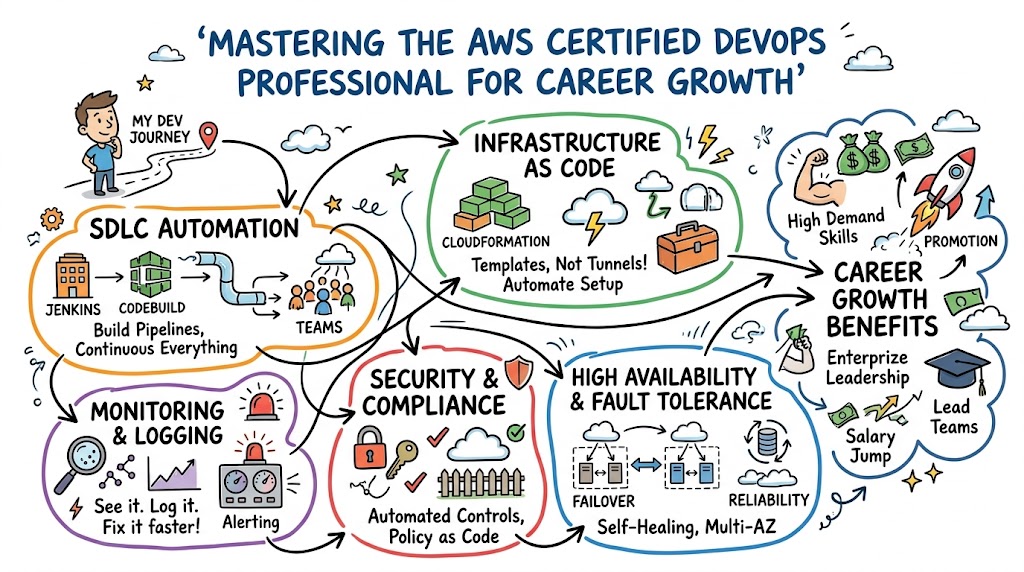
Obtaining the AWS Certified DevOps Professional designation represents a significant milestone for any engineer looking to lead in the cloud-native era. This guide is specifically designed for technical practitioners and engineering leaders who want to move beyond basic automation into the realm of complex, distributed system management. As organizations shift toward platform engineering and site reliability practices, understanding the depth of this certification helps you navigate the high-velocity requirements of modern software delivery. By focusing on the intersection of development and operations within the Amazon Web Services ecosystem, this resource enables professionals to make informed decisions about their technical trajectory. DevOpsSchool provides the necessary framework to bridge the gap between theoretical cloud knowledge and the rugged realities of production environments.
What is the AWS Certified DevOps Professional?
The AWS Certified DevOps Professional represents the pinnacle of operational excellence within the most widely used cloud provider globally. It exists to validate an engineer’s ability to design, manage, and maintain automated infrastructure while ensuring high availability and scalability. Unlike entry-level certs, this focuses heavily on real-world production scenarios, such as zero-downtime deployments, complex rollback strategies, and multi-account security governance. It aligns perfectly with modern enterprise practices where speed of delivery must be balanced with strict compliance and cost-optimization metrics.
Who Should Pursue AWS Certified DevOps Professional?
This certification is primarily built for DevOps engineers, Senior SREs, and Cloud Architects who handle large-scale migrations and continuous delivery pipelines. While experienced engineers will find the content validates their years of troubleshooting, managers can use this knowledge to better lead technical teams through digital transformations. In the Indian market and across the global tech landscape, holding this credential signals a level of maturity that distinguishes a generalist from a specialist. Even security and data professionals benefit from this path as it provides the foundational automation skills required to secure and scale their respective domains.
Why AWS Certified DevOps Professional is Valuable and Beyond
The demand for professionals who can manage "Infrastructure as Code" continues to grow as enterprises move away from manual intervention. This certification offers long-term career longevity because it teaches principles of automation and monitoring that remain relevant even as specific tools evolve. By investing time into this track, professionals see a significant return through higher-tier job opportunities and the ability to command lead roles in platform engineering teams. It demonstrates a commitment to mastering the complexities of the cloud, ensuring you remain an indispensable asset in a competitive, automated job market.
AWS Certified DevOps Professional Certification Overview
This professional-level assessment utilizes a scenario-based approach, forcing candidates to solve architectural puzzles rather than just memorizing facts. The ownership of the learning journey remains with the candidate, though the structured curriculum provides the necessary guardrails for success. It covers everything from CI/CD patterns to automated healing, ensuring a comprehensive grasp of the entire application lifecycle.
AWS Certified DevOps Professional Certification Tracks & Levels
The certification journey typically begins with foundational or associate-level knowledge to build a baseline of AWS services. The professional level acts as the advanced tier, where specialization into DevOps practices becomes the primary focus for career progression. Beyond this, engineers often branch into specialty tracks such as Security, Advanced Networking, or Machine Learning to round out their expertise. These levels are designed to align with a natural career arc, moving from individual contributor roles to high-level system design and organizational leadership.
Complete AWS Certified DevOps Professional Certification Table
| Track | Level | Who it’s for | Prerequisites | Skills Covered | Recommended Order |
| Cloud Ops | Associate | Junior Engineers | Cloud Practitioner | Basic SysOps & Dev | 1 |
| DevOps | Professional | Senior Engineers | Associate Level | CI/CD, HA, Monitoring | 2 |
| Security | Specialty | Security Analysts | Professional Level | Encryption, IAM, Compliance | 3 |
| Networking | Specialty | Network Architects | Professional Level | Direct Connect, Hybrid Cloud | 4 |
Detailed Guide for Each AWS Certified DevOps Professional Certification
AWS Certified DevOps Professional – Professional Level
What it is
This certification validates technical expertise in provisioning, operating, and managing distributed application systems on the AWS platform. It specifically confirms your ability to implement and manage continuous delivery systems and methodologies.
Who should take it
It is intended for individuals who have two or more years of experience provisioning and managing AWS environments. It is ideal for those in DevOps or SRE roles who are responsible for the entire software development lifecycle.
Skills you’ll gain
- Implementation of highly available, scalable, and self-healing systems.
- Designing and managing tools to automate operational processes.
- Advanced proficiency in CI/CD pipeline construction.
- Expert-level monitoring, logging, and incident response automation.
Real-world projects you should be able to do
- Building a multi-region deployment pipeline with automated canary testing.
- Implementing a centralized logging solution for hundreds of microservices.
- Automating compliance audits and remediation using AWS Config and Lambda.
Preparation plan
- 7-14 Days: Focus on reviewing whitepapers and taking high-level practice exams to identify knowledge gaps.
- 30 Days: Dive deep into hands-on labs, specifically focusing on CodePipeline, CloudFormation, and OpsWorks.
- 60 Days: Perform extensive scenario-based testing and refine your understanding of cross-account IAM and security.
Common mistakes
- Underestimating the complexity of the scenario-based questions.
- Ignoring the "soft" aspects of DevOps like organizational culture and team communication.
- Failing to practice with real AWS accounts, leading to a lack of tactical experience.
Best next certification after this
- Same-track option: AWS Certified Security - Specialty
- Cross-track option: AWS Certified Advanced Networking - Specialty
- Leadership option: Certified Kubernetes Administrator (CKA) or Management Training
Choose Your Learning Path
DevOps Path
The DevOps path focuses heavily on the integration of development and operations through continuous automation. Engineers on this track will master the art of the pipeline, ensuring that code moves from a local machine to production with zero manual touchpoints. This involves deep knowledge of version control, automated testing, and deployment strategies like blue-green or canary releases. It is the most common path for those looking to speed up the delivery cycle within a product-led organization.
DevSecOps Path
The DevSecOps path integrates security directly into the heart of the automated pipeline. Instead of security being an afterthought, this path teaches professionals how to automate vulnerability scanning and compliance checks. You will learn to treat security policies as code, ensuring every deployment meets strict regulatory standards without slowing down the developers. This is highly valuable in finance, healthcare, and other regulated industries where data integrity is paramount.
SRE Path
The Site Reliability Engineering path shifts the focus toward the stability and performance of production systems. Professionals here use software engineering principles to solve operational problems, focusing on Service Level Objectives and Error Budgets. You will spend time learning about advanced monitoring, incident response automation, and capacity planning. This path is perfect for those who enjoy high-stakes troubleshooting and building resilient systems that can withstand massive traffic spikes.
AIOps Path
The AIOps path leverages machine learning to enhance and automate IT operations. By analyzing vast amounts of log data and metrics, engineers can predict outages before they happen and automate the remediation process. This path is ideal for those working in massive enterprise environments where manual monitoring is no longer feasible. It combines traditional DevOps skills with data science principles to create "intelligent" infrastructure.
MLOps Path
The MLOps path is specifically tailored for the lifecycle management of machine learning models. It addresses the unique challenges of versioning data, retraining models, and deploying them to production at scale. You will learn how to build pipelines that handle the heavy compute requirements of AI while ensuring model drift is monitored and corrected. This is a rapidly growing field as more companies integrate AI into their core product offerings.
DataOps Path
The DataOps path applies DevOps principles to data analytics and data engineering. It focuses on improving the quality and reducing the cycle time of data analytics by automating data integration and testing. Professionals on this track ensure that data pipelines are robust, scalable, and transparent to the business. It is essential for organizations that rely on real-time data to make critical business decisions.
FinOps Path
The FinOps path introduces financial accountability to the variable spend model of the cloud. It involves a cultural shift where engineering, finance, and business teams work together to optimize cloud costs. You will learn how to use tags, cost explorer, and automated scaling to ensure the organization only pays for what it truly needs. This path is becoming a requirement for engineering leaders who are responsible for massive cloud budgets.
Role → Recommended AWS Certified DevOps Professional Certifications
| Role | Recommended Certifications |
| DevOps Engineer | AWS DevOps Pro, CKA, Terraform Associate |
| SRE | AWS DevOps Pro, Prometheus/Grafana Certs |
| Platform Engineer | AWS DevOps Pro, CKAD, Pulumi/Ansible |
| Cloud Engineer | AWS SysOps Associate, AWS DevOps Pro |
| Security Engineer | AWS Security Specialty, DevSecOps Professional |
| Data Engineer | AWS Data Engineer Associate, DataOps Cert |
| FinOps Practitioner | FinOps Certified Practitioner, AWS DevOps Pro |
| Engineering Manager | AWS Cloud Practitioner, AWS DevOps Pro |
Next Certifications to Take After AWS Certified DevOps Professional
Same Track Progression
Once you have mastered the professional level, the logical next step is to go deeper into specific AWS service areas. This usually involves pursuing Specialty certifications that focus on high-level security or complex networking configurations. Deepening your expertise in these niches makes you the "go-to" expert for the most difficult architectural challenges. It solidifies your position as a technical lead within your organization.
Cross-Track Expansion
In today's multi-cloud world, broadening your skills to include other platforms or tool-agnostic certifications is highly beneficial. Consider looking into Kubernetes certifications or learning about competing cloud providers like Azure or GCP to understand different architectural patterns. This cross-pollination of ideas makes you a more versatile architect who can choose the best tool for any given job. It prevents "vendor lock-in" in your personal career growth.
Leadership & Management Track
For those looking to move into management, the focus should shift from "how" to "why." This involves learning about ITIL, PMP, or specific leadership frameworks that help you manage people and budgets as effectively as you manage servers. Transitioning to leadership requires a blend of technical credibility and emotional intelligence. Understanding the business value of DevOps is just as important as knowing how to write a Jenkinsfile.
Training & Certification Support Providers for AWS Certified DevOps Professional
DevOpsSchool offers a comprehensive curriculum that covers the entire breadth of the professional exam with a focus on hands-on labs and real-world scenarios. Their instructors are industry veterans who bring practical insights into the classroom, ensuring students learn more than just how to pass a test. The community support and extensive resource library make it a premier choice for serious candidates.Cotocus specializes in high-end consulting and training for cloud transformations, providing deep dives into automation and containerization. They focus on the enterprise level, helping large teams synchronize their skills with modern business requirements. Their training modules are often customized to reflect the specific tech stacks used by their corporate clients.Scmgalaxy has been a long-standing resource in the software configuration management space, providing a wealth of tutorials and community forums. They offer a grounded perspective on the evolution of DevOps tools and practices over the decades. It is an excellent place for engineers to find troubleshooting tips and deep technical articles.BestDevOps focuses on providing curated content and training for the most popular tools in the ecosystem, including AWS and Azure. They emphasize the "best practices" aspect of the industry, ensuring that engineers don't just build systems, but build them correctly. Their approach is highly practical and aimed at immediate job-readiness.devsecopsschool.com is the primary destination for engineers who want to specialize in the intersection of security and automation. They provide specific training on how to integrate security tools into CI/CD pipelines without creating bottlenecks. Their certifications are highly regarded by security-conscious organizations worldwide.sreschool.com focuses exclusively on the principles of Site Reliability Engineering, teaching professionals how to manage system uptime and performance at scale. They cover the essential mathematics of error budgets and the technical skills of automated incident response. It is the go-to spot for aspiring SREs.aiopsschool.com provides cutting-edge training on using artificial intelligence to manage complex IT environments. They teach students how to build and deploy machine learning models that can monitor and heal infrastructure. This is a niche but rapidly growing area of expertise.dataopsschool.com addresses the growing need for automation in the data world, providing frameworks for building resilient data pipelines. They focus on data quality, testing, and the continuous integration of data sources. It is perfect for data engineers looking to adopt a DevOps mindset.finopsschool.com helps professionals bridge the gap between cloud engineering and financial management. They provide the tools and cultural frameworks necessary to manage cloud spend effectively. This training is essential for anyone responsible for large-scale cloud budgets.
Frequently Asked Questions
- How hard is the AWS Certified DevOps Professional exam?
This exam is considered one of the most difficult in the AWS catalog due to its long, complex scenario questions. It requires not just knowledge of the services, but a deep understanding of how they interact under pressure.
- What is the recommended experience level for this certification?
AWS recommends at least two years of hands-on experience in provisioning and managing AWS environments before attempting the professional level. Practical experience is often the difference between passing and failing.
- Are there any mandatory prerequisites?
As of recent updates, there are no mandatory prerequisites, but it is highly recommended to have an Associate-level certification first. Jumping straight to Professional can be overwhelming for those without a solid foundation.
- How long does it take to prepare?
Most candidates spend between 2 to 4 months preparing, depending on their existing experience with the platform. Consistent hands-on practice is more important than hours spent reading books.
- What is the return on investment for this certification?
Professionals often see significant salary increases and access to more senior roles in cloud architecture and platform engineering. It is one of the highest-paying certifications in the IT industry today.
- Does this certification cover multi-cloud strategies?
While it focuses on AWS services, the principles of CI/CD, monitoring, and automation are applicable across any cloud provider. It builds a mindset that is valuable in any technical environment.
- How often do I need to recertify?
AWS certifications are typically valid for three years, after which you must pass the current version of the exam to maintain your status. This ensures that your skills remain up-to-date with the latest cloud innovations.
- Is the exam available online or at testing centers?
You can take the exam either at a physical testing center or through an online proctored environment from your home or office. Both options require strict adherence to security protocols.
- What is the format of the exam questions?
The exam consists of multiple-choice and multiple-response questions that are heavily scenario-based. You will often have to choose the "best" solution among several technically correct options.
- How does this compare to the Azure DevOps Engineer Expert?
Both certifications cover similar high-level concepts but focus on their respective cloud platforms and native tools. Choosing between them usually depends on which ecosystem your organization primarily uses.
- Can this help me move from a developer role to DevOps?
Absolutely, it provides the operational context that many developers lack, making you a much more well-rounded and valuable engineer. It bridges the gap between writing code and running code.
- Is training from providers like DevOpsSchool worth it?
Yes, structured training often provides the hands-on labs and expert guidance that are difficult to find through self-study alone. It can significantly shorten your learning curve.
FAQs on AWS Certified DevOps Professional
What is the passing score for the exam?The passing score is 750 out of 1000, using a scaled scoring model based on the difficulty of the questions.Does the exam include hands-on labs during the test?Currently, the exam is primarily multiple-choice, but the questions are designed to test your actual experience with the AWS console and CLI.Which AWS services are most prominent in the exam?Expect a heavy focus on AWS CloudFormation, OpsWorks, Elastic Beanstalk, CodePipeline, CodeDeploy, and various monitoring tools like CloudWatch and X-Ray.How many questions are on the exam and what is the time limit?There are typically 75 questions, and you are given 180 minutes to complete them, which requires a fast pace.Are there discounts available for the exam fee?AWS often provides 50% discount vouchers upon passing an associate exam, which can be applied to the professional level.What is the cost of the professional exam?The standard cost for a professional-level exam is 300 USD, though prices may vary by region or currency.Is there a specific focus on security in the DevOps exam?Yes, security is a major pillar, covering IAM policies, encryption, and automated compliance auditing throughout the entire lifecycle.Can I retake the exam if I fail?Yes, you must wait 14 days before you are eligible to retake the exam, and you must pay the full fee again.
Final Thoughts: Is AWS Certified DevOps Professional Worth It?
From a mentor's perspective, this certification is one of the few that truly tests your mettle as an engineer. It isn't just a piece of paper; the process of studying for it forces you to confront complex architectural challenges you might not see in your daily job. If you are looking to solidify your reputation as a senior practitioner and open doors to high-level engineering roles, the investment is absolutely worth it. It provides a standard language and framework that will serve you well regardless of where your career takes you. Focus on the learning journey and the hands-on skills rather than just the credentials, and the professional rewards will naturally follow.
