Comprehensive Guide to DevOps Certified Professional Success
Introduction
In the current landscape of software engineering, professionals must validate their skills through industry-recognized standards. The DevOps Certified Professional program offers a rigorous framework for mastering automation, culture, and platform engineering. Furthermore, this guide assists engineers and technical leaders in navigating the complexities of modern software delivery pipelines. Specifically, DevOpsschool provides the necessary resources and assessment criteria to ensure that candidates meet high-level industry requirements. Consequently, understanding this path helps you make informed career decisions and positions you as a leader in the cloud-native ecosystem.
What is the DevOps Certified Professional?
The DevOps Certified Professional designation represents a high-level mastery of the tools and philosophies that drive continuous integration and continuous delivery. Moreover, this program focuses heavily on production-grade environments rather than abstract concepts. Specifically, it exists to bridge the gap between academic knowledge and the practical demands of enterprise-level infrastructure management. Therefore, candidates engage with real-world scenarios that mimic the daily challenges faced by high-performing engineering teams. Ultimately, this credential signals to employers that an engineer possesses the technical depth required to manage complex modern workflows.
Who Should Pursue DevOps Certified Professional?
Software engineers who seek to move into leadership or specialized infrastructure roles find immense value in this certification. Additionally, Site Reliability Engineers and cloud architects utilize this path to formalize their experience with automation and monitoring frameworks. Furthermore, engineering managers in India and globally pursue this credential to better understand the technical hurdles their teams encounter. Even security professionals and data engineers benefit from the DevOps Certified Professional program because it emphasizes the cross-functional nature of modern platform engineering. Consequently, any professional involved in the software development lifecycle can leverage this certification for career advancement.
Why DevOps Certified Professional is Valuable for Future Careers
The demand for skilled automation experts continues to grow as organizations transition to fully cloud-native architectures. Therefore, holding a DevOps Certified Professional credential ensures that your skillset remains relevant even as individual tools evolve or disappear. Furthermore, enterprise adoption of these practices provides a long-term career safety net for those who can demonstrate deep technical proficiency. Specifically, the program emphasizes core principles like infrastructure as code and observability, which remain constant across different vendors. Consequently, the return on investment for your time and effort is exceptionally high in the current job market.
DevOps Certified Professional Certification Overview
DevOpsSchool delivers this comprehensive program through its official platform, ensuring that all modules align with current industry best practices. Moreover, the assessment approach focuses on hands-on labs and practical examinations rather than simple multiple-choice questions. Specifically, the structure involves several modules that cover the entire delivery pipeline, from source control to production monitoring. Therefore, the certification ownership lies with a body that understands the evolving needs of global tech hubs. Consequently, the program maintains its prestige by strictly validating the practical competence of every successful candidate.
DevOps Certified Professional Certification Tracks & Levels
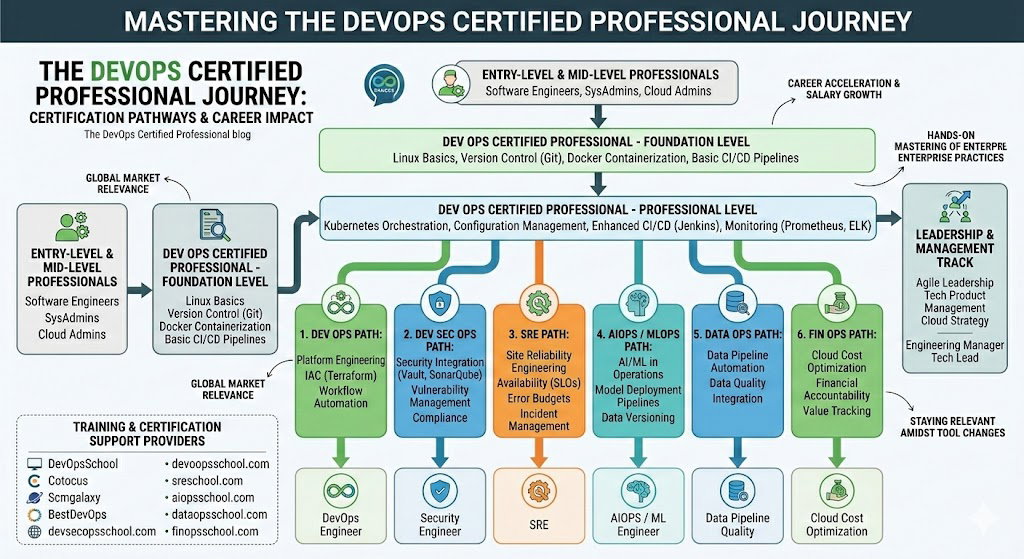
The certification framework includes foundation, professional, and advanced levels to cater to different career stages. First, the foundation level introduces core concepts of automation and culture for those entering the field. Second, the professional level dives deep into orchestration, configuration management, and cloud integration for experienced practitioners. Third, the advanced level focuses on architectural patterns, security integration, and complex migration strategies. Additionally, specialization tracks exist for those focusing on SRE, FinOps, or DevSecOps within the broader DevOps Certified Professional ecosystem. Consequently, this tiered approach allows for a logical and structured career progression over several years.
Complete DevOps Certified Professional Certification Table
| Track | Level | Who it’s for | Prerequisites | Skills Covered | Recommended Order |
| Core DevOps | Foundation | Beginners/Associates | Basic Linux knowledge | Git, Docker basics, CI/CD | First |
| Platform Engineering | Professional | Mid-level Engineers | Foundation Level | Kubernetes, Terraform, Jenkins | Second |
| SRE & Ops | Professional | SREs/SysAdmins | 2+ years experience | Prometheus, Grafana, Logging | Second |
| Architecture | Advanced | Senior Leads/Architects | Professional Level | Scalability, DR, Multi-cloud | Third |
| Security | Specialist | Security Engineers | Core DevOps knowledge | Vault, SonarQube, Compliance | Concurrent |
Detailed Guide for Each DevOps Certified Professional Certification
DevOps Certified Professional – Foundation Level
What it isThis certification validates a candidate's understanding of basic DevOps terminologies, culture, and the elementary tools used in the delivery pipeline. Furthermore, it serves as the entry point for all subsequent advanced certifications in the track.Who should take itAspiring DevOps engineers, fresh graduates, or traditional system administrators should pursue this level to build a strong conceptual base. Moreover, it is ideal for those looking to transition from manual operations to automated workflows.Skills you’ll gain
- Mastery of Version Control using Git
- Understanding of Containerization with Docker
- Basic Continuous Integration concepts
- Familiarity with Agile and DevOps culture
Real-world projects you should be able to do
- Create a simple Dockerized application
- Manage code branches and pull requests
- Set up a basic automated build pipeline
- Configure a local development environment
Preparation plan
- 7-14 Days: Focus on fundamental concepts and Git commands.
- 30 Days: Complete basic lab exercises and mock exams.
- 60 Days: Deep dive into container networking and basic automation scripts.
Common mistakes
- Ignoring the cultural aspects of DevOps in favor of tools.
- Underestimating the importance of Linux command-line proficiency.
Best next certification after this
- Same-track: Professional Level DevOps
- Cross-track: Cloud Associate Certification
- Leadership: Agile Project Management
DevOps Certified Professional – Professional Level
What it isThe Professional Level certification confirms your ability to design and manage complex automation systems and orchestration layers. Specifically, it proves that you can handle production-grade clusters and automated infrastructure provisioning.Who should take itExperienced software developers and system engineers who already manage some level of automation should take this exam. Additionally, it is suitable for professionals who want to lead technical implementations in a team setting.Skills you’ll gain
- Advanced Kubernetes Cluster Management
- Infrastructure as Code with Terraform
- Configuration Management using Ansible
- Complex CI/CD Pipeline Design
Real-world projects you should be able to do
- Deploy a multi-node Kubernetes cluster
- Automate infrastructure provisioning across multiple environments
- Implement blue-green or canary deployment strategies
- Manage secrets and configurations securely
Preparation plan
- 7-14 Days: Review advanced orchestration and IaC syntax.
- 30 Days: Build and tear down complex environments in a lab.
- 60 Days: Focus on troubleshooting and performance optimization scenarios.
Common mistakes
- Relying too heavily on GUI tools instead of command-line interfaces.
- Failing to practice disaster recovery scenarios during preparation.
Best next certification after this
- Same-track: Advanced Architect Level
- Cross-track: SRE Professional
- Leadership: Technical Lead Certification
DevOps Certified Professional – Advanced Level
What it isThis certification validates the expertise required to architect enterprise-scale platforms and lead organization-wide digital transformations. Furthermore, it focuses on high-level strategy, cost optimization, and security governance.Who should take itPrincipal engineers, technical architects, and senior consultants who design end-to-end delivery ecosystems should pursue this level. Specifically, it targets those responsible for the long-term reliability and scalability of global platforms.Skills you’ll gain
- Multi-cloud Architecture Design
- Enterprise Security Governance
- Advanced Observability and AIOps integration
- Strategic Resource Planning
Real-world projects you should be able to do
- Design a zero-trust security architecture for a global app
- Optimize cloud spend across multiple business units
- Lead a massive migration from legacy to cloud-native
- Implement auto-remediation systems using AIOps
Preparation plan
- 7-14 Days: Analyze case studies of successful enterprise transformations.
- 30 Days: Focus on compliance frameworks and financial modeling for cloud.
- 60 Days: Conduct architectural reviews and design complex failover systems.
Common mistakes
- Focusing only on technology while ignoring business objectives.
- Over-engineering solutions that are difficult to maintain.
Best next certification after this
- Same-track: Specialized FinOps or DataOps
- Cross-track: Security Architect
- Leadership: Engineering Director / CTO track
Choose Your Learning Path
DevOps Path
The DevOps path focuses primarily on the lifecycle of application delivery and developer productivity. Consequently, you start with foundational automation tools and move toward advanced orchestration and infrastructure management. Furthermore, this path emphasizes the "Shift Left" philosophy to ensure quality is integrated early in the process. Therefore, professionals in this track become experts in Jenkins, Docker, and Kubernetes. Ultimately, this leads to a career as a Senior DevOps Engineer or Platform Lead.
DevSecOps Path
The DevSecOps path integrates security protocols directly into the automated delivery pipeline. Specifically, you learn how to perform automated vulnerability scanning and secret management without slowing down development. Moreover, this track ensures that compliance and governance become part of the code itself. Therefore, you gain expertise in tools like Vault, SonarQube, and Checkmarx. Consequently, this path is ideal for engineers who want to specialize in high-stakes, security-conscious industries.
SRE Path
The SRE path emphasizes the reliability and scalability of production systems through software engineering principles. Furthermore, you focus on monitoring, incident response, and capacity planning to ensure high availability. Specifically, this track teaches you how to balance the need for new features with the requirement for system stability. Therefore, you spend significant time mastering Prometheus, Grafana, and ELK stacks. Consequently, professionals here often move into Site Reliability or Operations Leadership roles.
AIOps / MLOps Path
The AIOps and MLOps path bridges the gap between data science and operational excellence. Specifically, you learn how to automate the deployment and monitoring of machine learning models in production. Furthermore, this track utilizes artificial intelligence to enhance traditional monitoring and troubleshooting. Therefore, you become proficient in managing GPU clusters and data pipelines. Consequently, this is the perfect path for engineers looking to support modern AI-driven organizations.
DataOps Path
The DataOps path applies DevOps principles to data management and analytics workflows. Specifically, you focus on automating data integration, quality checks, and delivery to end-users. Furthermore, this track ensures that data scientists have reliable and up-to-date information for their models. Therefore, you gain skills in managing Big Data tools and cloud-based data warehouses. Consequently, this path leads to specialized roles in data engineering and platform support.
FinOps Path
The FinOps path focuses on the financial management and cost optimization of cloud resources. Specifically, you learn how to align cloud spending with business value through visibility and accountability. Furthermore, this track teaches you how to implement automated cost-saving policies across large organizations. Therefore, you become an expert in tagging strategies and reservation management. Consequently, this path is highly valued by enterprises looking to maximize their return on cloud investments.
Role → Recommended DevOps Certified Professional Certifications
| Role | Recommended Certifications |
| DevOps Engineer | Foundation + Professional (Core Track) |
| SRE | Professional (SRE Track) + Foundation |
| Platform Engineer | Professional + Advanced (Platform Track) |
| Cloud Engineer | Foundation + Professional (Cloud Track) |
| Security Engineer | Foundation + DevSecOps Specialist |
| Data Engineer | Foundation + DataOps Specialist |
| FinOps Practitioner | Foundation + FinOps Specialist |
| Engineering Manager | Foundation + Advanced (Leadership Track) |
Next Certifications to Take After DevOps Certified Professional
Same Track Progression
Deep specialization allows you to become the go-to expert for specific technological domains within your organization. Specifically, once you complete the professional level, you should target advanced certifications that focus on high-scale architecture. Furthermore, staying within the same track ensures that you develop a cohesive and powerful skillset that is difficult to replicate. Therefore, you should look for credentials that validate your ability to handle multi-region and multi-cloud complexities. Ultimately, this progression leads to becoming a Distinguished Engineer or a Fellow in your technical community.
Cross-Track Expansion
Broadening your skills into adjacent domains like security or data management makes you a more versatile professional. Furthermore, understanding how SRE principles apply to traditional DevOps workflows allows you to design more resilient systems. Specifically, cross-training helps you communicate more effectively with different teams across the organization. Therefore, you should consider taking a specialist certification in a different track every year to keep your knowledge fresh. Consequently, this approach prevents professional stagnation and opens up diverse career opportunities.
Leadership & Management Track
Transitioning into leadership requires a shift from technical execution to strategic planning and people management. Furthermore, you must learn how to justify technical investments to non-technical stakeholders in the business. Specifically, certifications in this track focus on team building, budget management, and organizational culture. Therefore, you should combine your technical DevOps Certified Professional status with management-focused credentials. Consequently, this prepares you for roles such as Engineering Manager, VP of Engineering, or CTO.
Training & Certification Support Providers for DevOps Certified Professional
DevOpsSchool
DevOpsSchool functions as a premier institution for those seeking comprehensive training and certification in the DevOps domain. Specifically, they provide an extensive library of recorded sessions and live instructor-led workshops that cater to various learning styles. Furthermore, their curriculum is designed by industry veterans who bring decades of real-world experience to the classroom. Therefore, students receive not only theoretical knowledge but also practical insights into production challenges. Additionally, the platform offers robust lab environments where candidates can practice complex scenarios without any local setup. Consequently, DevOpsSchool remains a top choice for professionals looking for a structured and mentored learning path.
Cotocus
Cotocus specializes in high-end corporate training and consulting, making it a valuable partner for organizations undergoing digital transformation. Specifically, they tailor their DevOps Certified Professional programs to meet the specific technological stacks of their clients. Furthermore, their trainers focus on immediate application, ensuring that teams can implement what they learn within days. Therefore, Cotocus is often chosen by large enterprises to upskill their workforce in a consistent and efficient manner. Additionally, they provide ongoing support and mentoring to ensure that the transition to new workflows is successful. Consequently, their reputation for excellence in enterprise training is well-earned.
Scmgalaxy
Scmgalaxy provides a vast repository of resources focused on software configuration management and the broader DevOps ecosystem. Specifically, their community-driven approach offers learners access to thousands of tutorials, scripts, and best-practice documents. Furthermore, they host frequent webinars and meetups that allow professionals to network and share their experiences. Therefore, it serves as an excellent supplementary resource for anyone preparing for the DevOps Certified Professional exam. Additionally, their focus on automation scripts and CI/CD tools helps candidates master the technical details required for certification. Consequently, Scmgalaxy is a cornerstone of the global DevOps learning community.
BestDevOps
BestDevOps focuses on providing highly curated content and specialized coaching for senior engineering professionals. Specifically, they offer deep dives into advanced topics such as cloud-native architecture and SRE methodologies. Furthermore, their small-batch training sessions ensure that every participant receives personalized attention from the instructor. Therefore, it is an ideal platform for those who prefer a more intimate and focused learning environment. Additionally, they provide career coaching and interview preparation as part of their comprehensive certification packages. Consequently, BestDevOps helps professionals not only get certified but also land high-impact roles in the industry.
devsecopsschool.com
This platform focuses exclusively on the intersection of security and DevOps, providing specialized training for modern security engineers. Specifically, devsecopsschool.com teaches candidates how to integrate automated security checks into every stage of the pipeline. Furthermore, they cover complex topics such as container security, network policies, and compliance as code. Therefore, it is the go-to resource for professionals who want to lead security initiatives in a cloud-native world. Additionally, their labs provide hands-on experience with industry-standard security tools. Consequently, they play a critical role in producing the next generation of DevSecOps experts.
sreschool.com
Sreschool.com is dedicated to the principles of Site Reliability Engineering and system stability. Specifically, their courses cover the mathematical and engineering aspects of maintaining high-availability platforms. Furthermore, they emphasize the importance of service level objectives and error budgets in modern operations. Therefore, students learn how to manage production incidents with confidence and precision. Additionally, the platform provides detailed training on observability tools and incident management frameworks. Consequently, sreschool.com is an essential resource for engineers who are responsible for the uptime of critical business services.
aiopsschool.com
Aiopsschool.com leads the way in training professionals for the future of AI-driven operations. Specifically, they teach how to leverage machine learning algorithms to predict and remediate system failures. Furthermore, their curriculum covers the automation of data pipelines and the management of large-scale AI infrastructure. Therefore, it is a vital platform for engineers who want to stay at the cutting edge of technological innovation. Additionally, they provide insights into how AI can optimize resource allocation and reduce operational overhead. Consequently, aiopsschool.com prepares candidates for the most advanced roles in the modern tech landscape.
dataopsschool.com
Dataopsschool.com provides specialized training for managing data as a first-class citizen in the DevOps world. Specifically, they focus on the automation of data delivery and the maintenance of data quality across the lifecycle. Furthermore, their courses bridge the gap between traditional database administration and modern cloud-native data engineering. Therefore, they enable professionals to build robust and scalable data platforms that support real-time analytics. Additionally, their training includes hands-on work with modern data orchestration and warehouse tools. Consequently, dataopsschool.com is the primary destination for data professionals seeking DevOps expertise.
finopsschool.com
Finopsschool.com addresses the growing need for financial accountability and cost optimization in the cloud. Specifically, they provide a structured framework for managing cloud spend through culture and automation. Furthermore, their training helps organizations break down silos between finance, engineering, and business teams. Therefore, candidates learn how to maximize the value of every dollar spent on cloud resources. Additionally, the platform offers specialized certifications for FinOps practitioners and leaders. Consequently, finopsschool.com is instrumental in helping businesses achieve long-term financial sustainability in their cloud journeys.
Frequently Asked Questions (General)
- How difficult is the DevOps Certified Professional exam?The difficulty level is moderate to high because it requires a deep understanding of practical tool usage. Consequently, candidates with hands-on experience find it more manageable than those who only study theory.
- How much time is required to prepare for this certification?Generally, a dedicated professional requires about 30 to 60 days of consistent study and lab practice. Furthermore, the timeframe depends on your existing familiarity with Linux and automation tools.
- Are there any specific prerequisites for the foundation level?No formal prerequisites exist for the foundation level, but basic knowledge of the Linux command line is highly recommended. Specifically, understanding file systems and basic networking will accelerate your learning.
- What is the return on investment for this certification?Professionals often see significant salary increases and better job opportunities immediately after becoming a DevOps Certified Professional. Therefore, it is considered one of the most high-value investments in technical education.
- Is there a recommended order for taking these certifications?Yes, it is highly recommended to start with the foundation level before moving to professional or specialized tracks. Consequently, you build a solid knowledge base that makes advanced topics much easier to grasp.
- Can I take the exam online or do I need to visit a center?Most assessments are delivered online through a proctored environment, providing flexibility for global candidates. Furthermore, you will need a stable internet connection and a compatible computer for the practical labs.
- How long is the certification valid for?The certification typically remains valid for two to three years, reflecting the rapid changes in the technology landscape. Therefore, you will need to renew it or progress to a higher level to stay current.
- Does the program cover multiple cloud providers?Specifically, the core principles taught are cloud-agnostic, but labs often utilize major providers like AWS or Azure. Consequently, you gain skills that are applicable across any modern cloud environment.
- What kind of support is available if I fail the exam?Most training providers offer a retake policy and additional mentoring to help you identify and bridge your knowledge gaps. Furthermore, you can access community forums for peer support and guidance.
- Is this certification recognized by major tech companies?Yes, the DevOps Certified Professional credential is highly regarded by enterprises and startups globally. Therefore, it serves as a powerful validation of your skills during the hiring process.
- Are there any group discounts for corporate teams?Many support providers like Cotocus offer specialized pricing for corporate groups and team upskilling programs. Specifically, they can customize the delivery to align with your organization's goals.
- What language is the exam conducted in?The primary language for the exam and all study materials is English. Furthermore, the technical nature of the content ensures that the terminology is consistent with global industry standards.
FAQs on DevOps Certified Professional
- What specific tools are covered in the core track?The core track covers essential tools like Git, Jenkins, Docker, Kubernetes, Terraform, and Ansible. Consequently, you gain a comprehensive toolkit for modern automation.
- How does this certification differ from vendor-specific ones?Unlike AWS or Azure certifications, this program focuses on the entire lifecycle and multi-tool integration. Therefore, it provides a more holistic view of platform engineering.
- Is coding knowledge required for the professional level?While you do not need to be a full-stack developer, a basic understanding of scripting and YAML is essential. Specifically, you must be comfortable writing automation scripts.
- Does the program include real-world project work?Yes, the certification requires the completion of several production-grade projects in a lab environment. Furthermore, these projects mimic the actual tasks you will perform on the job.
- Can a manager benefit from this technical certification?Absolutely, because it provides the technical context needed to lead engineering teams effectively. Consequently, managers can make more informed decisions about tool selection and deadlines.
- What is the passing score for the final assessment?The passing score is usually set around 70%, ensuring that only those with a high degree of competence receive the credential. Therefore, thorough preparation is necessary.
- Are there any labs included in the study materials?Yes, the program provides access to comprehensive cloud-based labs for hands-on practice. Specifically, these labs are available 24/7 during your preparation period.
- How does the certification help with job interviews?It provides a structured way to talk about your skills and experience during technical rounds. Furthermore, it gives hiring managers confidence in your ability to handle complex systems.
Final Thoughts: Is DevOps Certified Professional Worth It?
Investing in the DevOps Certified Professional credential is a strategic move for any engineer serious about their long-term career growth. Moreover, the program forces you to move beyond basic automation and master the complexities of modern, scalable infrastructure. Specifically, the hands-on nature of the certification ensures that you are ready for production challenges from day one. Therefore, while the path requires significant effort and dedication, the resulting professional authority and marketability are well worth the investment. Ultimately, this certification serves as a testament to your commitment to excellence in the ever-evolving field of platform engineering.
