Master Your Career with the DevOps Engineering (MDE) Certification
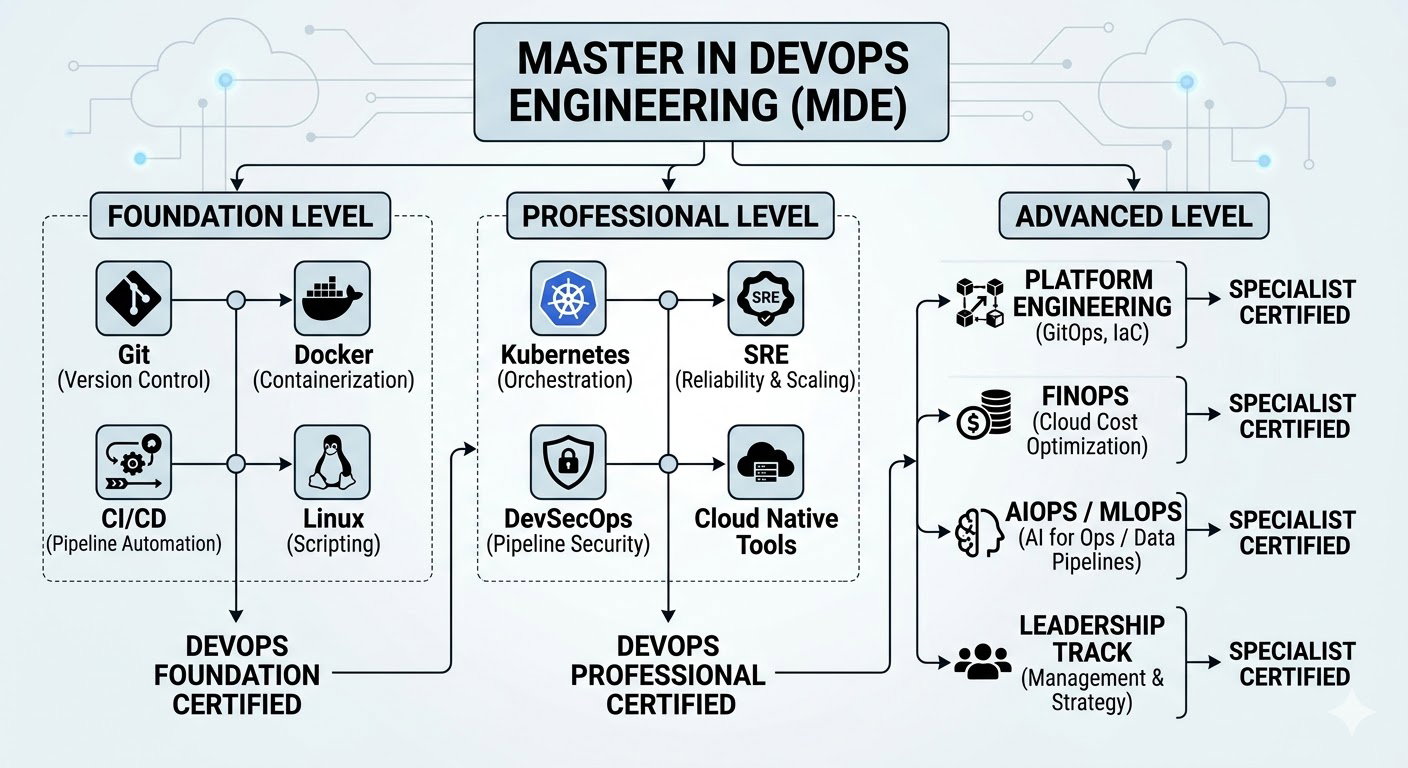
Today’s software landscape demands more than just basic tool knowledge; it requires a deep, holistic grasp of the entire delivery lifecycle. Professionals who want to bridge the gap between development and operations should consider the Master in DevOps Engineering (MDE) program. This guide explores how this advanced curriculum helps you stay competitive in a world of cloud-native and platform engineering. By focusing on production-ready skills rather than dry theory, this certification empowers you to make smarter career moves. You can find the full program details at DevOpsSchool, a leading platform for technical mastery.
Understanding the Master in DevOps Engineering (MDE)
The Master in DevOps Engineering (MDE) serves as a high-level validation for engineers who design and manage complex CI/CD pipelines. It exists because modern enterprises need a structured roadmap to navigate the intersection of culture, process, and technology. Furthermore, the curriculum prioritizes real-world, production-focused learning over academic speculation. It aligns perfectly with modern engineering workflows by integrating Infrastructure as Code, automated testing, and deep observability. Companies actively seek practitioners who can handle the rigors of high-scale enterprise practices.
Who Benefits Most from This Certification?
Software engineers, SREs, and cloud professionals find immense value in this program. Security analysts looking to transition into DevSecOps and data experts moving toward DataOps also benefit significantly. While beginners with strong Linux foundations will find it challenging, it offers a rewarding path to senior roles. Moreover, engineering managers and technical leads gain the depth required to guide high-performing teams. This credential carries immense weight in both the global and Indian tech markets.
The Lasting Value of MDE in a Rapidly Changing Market
Organizations continue to move away from legacy systems toward microservices, creating a massive demand for DevOps expertise. Because the Master in DevOps Engineering (MDE) focuses on core principles, it remains relevant even when specific tools change. Consequently, professionals see a high return on their time investment by consolidating diverse skills into a single framework. As platform engineering gains traction, this master-level credential proves you can manage architectural complexity. Investing in this path ensures long-term career stability and significant salary growth.
Program Overview and Hosting
which is delivered by DevOpsSchool. Students undergo a multi-level assessment process involving hands-on labs, real-time projects, and rigorous examinations. This structure ensures you apply your knowledge to solve actual business problems rather than just memorizing facts. Industry veterans regularly update the modules to reflect current shifts in the tech world. The practical progression moves you from foundational automation to advanced enterprise strategies.
Available Tracks and Career Levels
The certification features foundation, professional, and advanced levels to match various career stages. While the foundation level covers basic cloud concepts, the professional level dives into orchestration and monitoring. The advanced level challenges senior engineers with architectural design and scaling strategies. Additionally, specialized tracks for SRE, FinOps, and DevSecOps allow you to tailor your education. These levels mirror natural career progression, helping you move from an individual contributor to a technical lead.
Comprehensive Certification Breakdown
| Track | Level | Ideal Candidate | Prerequisites | Key Skills | Recommended Order |
| Core DevOps | Foundation | Junior Engineers | Linux Basics | Git, Docker, Jenkins | 1 |
| SRE Track | Professional | Ops Professionals | Core DevOps | K8s, Prometheus, SLIs | 2 |
| Security | Advanced | Security Analysts | Professional Level | Vault, Compliance | 3 |
| Platform | Advanced | Senior Engineers | Multi-Cloud | Terraform, Mesh | 4 |
| FinOps | Professional | Technical Leads | Cloud Billing | Cost Management | 5 |
Detailed Guide for MDE Certifications
Master in DevOps Engineering (MDE) – Foundation Level
What it isThis certification confirms your grasp of the basic DevOps philosophy and the essential toolchain. It acts as the primary entry point for cloud-focused career paths.Who should take itJunior developers and system administrators find this level most useful. You do not need prior DevOps experience, though basic programming knowledge helps.Skills you’ll gain
- Manage version control with Git.
- Utilize Docker for containerization.
- Automate builds with Jenkins.
- Provision basic cloud infrastructure.
Production-grade outcomes
- Build a functional CI/CD pipeline for web apps.
- Deploy containerized applications locally.
- Script basic system administration tasks.
Preparation Strategy
- 14 Days: Focus on Git and Docker architecture.
- 30 Days: Practice Jenkins labs and shell scripting.
- 60 Days: Complete a full end-to-end pipeline project.
Common Mistakes
- Focusing only on tools while ignoring cultural shifts.
- Neglecting command-line practice.
Follow-up Certifications
- Same-track: Professional Level MDE.
- Cross-track: DevSecOps Foundation.
- Leadership: DevOps for Managers.
Master in DevOps Engineering (MDE) – Professional Level
What it isThe Professional Level validates your ability to manage production-grade environments with high availability. It proves you can handle complex orchestration and configuration tasks.Who should take itEngineers with two to three years of experience should pursue this level. It specifically targets those aiming for SRE or Senior DevOps roles.Skills you’ll gain
- Manage Kubernetes clusters at scale.
- Use Ansible for configuration management.
- Implement Infrastructure as Code with Terraform.
- Monitor systems with ELK and Prometheus.
Production-grade outcomes
- Deploy microservices on high-availability Kubernetes.
- Create reusable multi-cloud Terraform modules.
- Build automated alerting based on metrics.
Preparation Strategy
- 14 Days: Study Kubernetes objects and controllers.
- 30 Days: Master Ansible and Terraform state.
- 60 Days: Perform complex migration and troubleshooting.
Common Mistakes
- Underestimating Kubernetes networking complexity.
- Confusing imperative and declarative tool logics.
Follow-up Certifications
- Same-track: Advanced MDE Architect.
- Cross-track: Cloud Security Professional.
- Leadership: Technical Lead Certification.
Selecting Your Professional Learning Path
DevOps PathThis path focuses on integrating development and operations through total automation. You learn to reduce time-to-market by removing silos and automating testing. It represents the standard route for mastering the modern CI/CD ecosystem.DevSecOps PathSecurity becomes a core part of the pipeline in this specialized track. You learn to automate security scanning and manage secrets without slowing down delivery. This path suits engineers working in highly regulated industries.SRE PathThe SRE path applies software engineering principles to solve operational problems. You study reliability patterns, error budgets, and incident response management. It serves engineers who enjoy deep-diving into system performance.AIOps / MLOps PathThis track covers the operationalization of machine learning and the use of AI for IT operations. You build pipelines for large datasets and predictive maintenance. It bridges the gap between data science and infrastructure.DataOps PathDataOps professionals improve the quality and cycle time of data analytics. You apply DevOps principles to data pipelines and automate database management. This ensures data flows smoothly from source to user.FinOps PathThis path focuses on cloud financial management and cost optimization. You bring accountability to cloud spending through tagging and budgeting. It requires a unique mix of technical and financial skill.
Mapping Roles to Certifications
| Professional Role | Recommended Certifications |
| DevOps Engineer | MDE Foundation + MDE Professional |
| SRE | MDE Professional + SRE Advanced |
| Platform Engineer | MDE Professional + Infrastructure Specialist |
| Cloud Engineer | MDE Foundation + Cloud Native Track |
| Security Engineer | MDE Foundation + DevSecOps Advanced |
| Data Engineer | MDE Foundation + DataOps Track |
| FinOps Practitioner | MDE Foundation + FinOps Professional |
| Engineering Manager | MDE Foundation + DevOps Leadership |
Advancing After the MDE Certification
Same Track ProgressionAfter finishing the MDE, you should seek deep specialization in specific technologies. This might include expert-level Kubernetes or specific cloud architecture certifications. Becoming a subject matter expert makes you indispensable to your team.Cross-Track ExpansionExpanding into DevSecOps or DataOps creates a more versatile professional profile. Broadening your skills allows you to contribute to a wider range of enterprise projects. This "T-shaped" skill set increases your flexibility in the job market.Leadership & Management TrackEngineers who want to move away from coding can transition into management. This requires learning about team dynamics and strategic planning. Your MDE background provides the technical credibility needed to lead engineers effectively.
Top Training and Support Providers
DevOpsSchoolDevOpsSchool offers a robust ecosystem with instructor-led sessions and hands-on labs. Their trainers bring real-world experience to the classroom, ensuring students learn more than just theory.CotocusCotocus specializes in technical training for corporate needs and specialized workshops. They help teams transition to cloud-native technologies through highly practical, immediate-use programs.ScmgalaxyScmgalaxy provides a community-driven platform with vast resources on configuration management. It offers a mix of free tutorials and premium support for various technical tracks.BestDevOpsBestDevOps focuses on the best industry practices to provide a streamlined learning experience. They concentrate on high-impact skills that drive immediate career growth.devsecopsschool.comThis platform serves as the primary resource for integrating security into DevOps. They provide detailed modules on vulnerability management and secure coding practices.sreschool.comSreschool.com focuses on Site Reliability Engineering, covering chaos engineering and reliability patterns. It provides a clear path for those maintaining large-scale systems.aiopsschool.comThis provider addresses the need for AI in IT operations. They teach engineers how to use machine learning for predictive maintenance and log analysis.dataopsschool.comDataopsschool.com applies DevOps agility to data engineering. They help break down silos between data scientists and operations teams through automation.finopsschool.comFinopsschool.com offers specialized training in cloud financial management. They teach practitioners how to optimize cloud spend without sacrificing innovation.
General Frequently Asked Questions
- Do beginners find the MDE difficult?While the foundation is accessible, the advanced levels require significant effort.
- How long does the program take?Most students finish within six to twelve months.
- Are there prerequisites?You should know Linux and at least one programming language.
- What is the ROI?Certified engineers typically see higher salaries and better job titles.
- Can I change the order of certifications?We recommend following the foundation-to-advanced sequence.
- Is the exam hands-on?Yes, it involves solving real-world problems in a live lab.
- Does it expire?Renewal is usually required every two to three years.
- Is it recognized in India?Yes, it carries significant weight in India and global tech hubs.
- How does it differ from vendor certs?It provides a broader, tool-agnostic understanding of the ecosystem.
- Are there study groups?Providers like DevOpsSchool offer community forums and groups.
- Must I be a developer?You don't need to be a full-stack developer, but scripting is vital.
- What jobs can I get?You can work as a DevOps Engineer, SRE, or Cloud Architect.
Specific FAQs on MDE
- How is MDE unique?It prioritizes hands-on engineering over academic theory.
- How often do you update the curriculum?We refresh the modules quarterly to include new tools.
- Can I study while working?Yes, the program offers flexible, self-paced options.
- Is there job placement support?Most providers offer resume building and interview coaching.
- What tools do I learn?You master Docker, Kubernetes, Terraform, and Jenkins.
- Are cloud platforms included?Yes, we cover AWS, Azure, and Google Cloud services.
- Is a final project required?The advanced level requires a production-grade capstone project.
- Who teaches the courses?Industry veterans with over a decade of experience lead the training.
Is the Master in DevOps Engineering (MDE) Worth the Effort?
Committing to the Master in DevOps Engineering (MDE) represents a significant career investment. The true value lies in the structured discipline it brings to your professional development. In a field where tools change rapidly, a deep understanding of core principles separates senior leaders from basic technicians. If you are willing to build the labs and master the "why" behind the automation, this program will reward you. Focus on the skills, remain curious, and the career growth will follow naturally.
