Master the Future of Systems: SRE Certified Professional Training Guide
Introduction
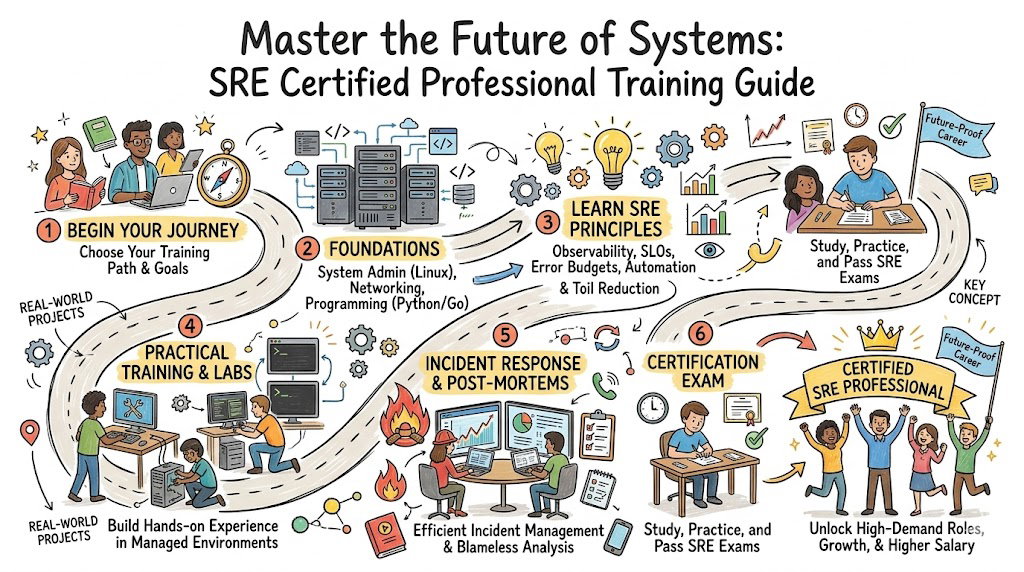
Modern digital ecosystems require more than just basic uptime; they demand extreme resilience and scalability. The SRE Certified Professional (Training & Certification) serves as the definitive roadmap for engineers who want to bridge the gap between software development and systems operations. This guide helps DevOpsschool learners and technical leaders navigate the transition from traditional admin roles to high-impact site reliability engineering. As platform engineering and cloud-native architectures become the industry standard, mastering SRE principles like Error Budgets and SLOs becomes a critical career move. This comprehensive breakdown allows you to evaluate the certification's impact and choose a learning path that ensures long-term professional growth.
What is the SRE Certified Professional (Training & Certification)?
The SRE Certified Professional (Training & Certification) represents a sophisticated approach to operations that treats infrastructure as a software problem. It exists because traditional operations methods cannot keep pace with the scale and speed of modern cloud-native applications. This program moves away from manual intervention and emphasizes an engineering-first mindset focused on automation and high-level systems design.Engineers learn to apply software engineering discipline to operational challenges, ensuring that systems remain reliable even under heavy load. The certification prioritizes production-focused learning, teaching practitioners how to balance the need for new features with the requirement for system stability. By aligning with modern enterprise practices, it validates an individual's ability to manage complex distributed systems using data-driven decision-making.
Who Should Pursue SRE Certified Professional (Training & Certification)?
Software engineers who enjoy solving infrastructure puzzles and systems administrators looking to modernize their skills should pursue this path. It is also highly relevant for Cloud Architects and Platform Engineers who must design resilient environments that support rapid deployment cycles. The certification provides a structured way for professionals to move into high-demand roles that prioritize system health and reliability.In the global market, especially within India's growing tech hubs, SREs are among the most sought-after professionals for high-scale digital platforms. Beginners use this certification to build a solid foundation in reliability, while senior engineers use it to formalize their experience and move into architectural roles. Engineering managers also benefit by learning how to structure teams to reduce toil and improve the overall developer experience.
Why SRE Certified Professional (Training & Certification) is Valuable in 2026 and Beyond
As systems grow in complexity through 2026, the demand for reliability expertise continues to outpace the supply of qualified engineers. This certification ensures your longevity in the field by teaching you core principles that remain relevant regardless of which cloud provider or tool is currently popular. Organizations prioritize engineers who can protect their revenue and reputation by maintaining high availability in mission-critical systems.Enterprise adoption of the SRE model has expanded from tech giants to traditional sectors like banking, healthcare, and retail. This shift creates a massive career investment opportunity for those who can navigate observability and incident management effectively. Earning this credential proves you can handle the scale of modern business, making you an indispensable asset to any organization focused on digital excellence.
SRE Certified Professional (Training & Certification) Certification Overview
The training program delivers its curriculum through specialized modules and hosts all learning materials on the DevOpsschool platform. Candidates undergo a rigorous assessment process that includes both technical examinations and scenario-based problem-solving tasks. This ensures that every certified individual can handle real-world production incidents and implement proactive reliability strategies.The program structure covers essential domains such as monitoring, alerting, incident response, and post-mortem analysis. It is owned and updated by industry experts who actively manage large-scale systems, ensuring the content reflects current production challenges. This practical focus makes the certification a reliable indicator of an engineer's ability to maintain complex cloud environments.
SRE Certified Professional (Training & Certification) Certification Tracks & Levels
The certification tracks begin at the foundation level, where engineers master the fundamental vocabulary and philosophy of Site Reliability Engineering. As professionals move to the professional level, they focus on hands-on automation and implementing Service Level Objectives (SLOs) using advanced tools. Advanced levels target architectural resilience, teaching experts how to design systems that survive regional cloud outages.Specialization tracks allow SREs to focus on specific niches such as FinOps for cost reliability or DevSecOps for secure availability. These levels ensure that as your career progresses, your certifications align with your increasing responsibility for global system design. This structured approach helps engineers move systematically from individual contributors to strategic technical leaders.
Complete SRE Certified Professional (Training & Certification) Certification Table
| Track | Level | Who it’s for | Prerequisites | Skills Covered | Recommended Order |
| Core SRE | Foundation | Junior Devs | Basic Coding | SLIs, SLOs, Toil | 1 |
| SRE Engineer | Professional | SREs, Ops Pros | 2+ Years Exp | Automation, Python | 2 |
| Reliability Architect | Advanced | Senior SREs | Prof. Cert | DR, High Availability | 3 |
| SRE Leader | Leadership | Managers | Prof. Cert | Culture, Team Growth | 4 |
| Data SRE | Specialized | Data Engineers | SQL, Python | Pipeline Reliability | 2 |
| Security SRE | Specialized | Security Pros | DevSecOps Basics | Secure Resilience | 2 |
Detailed Guide for Each SRE Certified Professional (Training & Certification) Certification
SRE Certified Professional (Training & Certification) – Foundation
What it isThis certification validates an entry-level understanding of SRE concepts, focusing on Service Level Indicators (SLIs) and the management of Error Budgets.Who should take itIt is designed for developers and junior operations staff who want to adopt an SRE mindset and understand the basic pillars of reliability.Skills you’ll gain
- Understanding the difference between SLAs, SLOs, and SLIs.
- Identifying and quantifying operational toil in a system.
- Learning the principles of blameless post-mortem analysis.
- Grasping the basics of monitoring and observability.
Real-world projects you should be able to do
- Designing a basic SLO for a web application.
- Creating a dashboard to track error budget consumption.
- Identifying five manual tasks that qualify as toil for automation.
Preparation plan
- 7–14 days: Review the core definitions and the SRE handbook summaries.
- 30 days: Practice building monitoring dashboards in a lab environment.
- 60 days: Analyze real-world case studies of system failures and recovery.
Common mistakes
- Confusing Service Level Agreements with Service Level Objectives.
- Focusing too much on tools instead of the SRE cultural shift.
Best next certification after this
- Same-track option: SRE Professional Level.
- Cross-track option: DevOps Associate.
- Leadership option: SRE Culture Lead.
Choose Your Learning Path
DevOps Path
The DevOps path focuses on the speed of delivery without compromising the stability of the platform. Engineers learn how to integrate SRE checks directly into the CI/CD pipeline, ensuring that every release meets reliability standards. This path emphasizes the synergy between rapid software iterations and a healthy production environment.
DevSecOps Path
The DevSecOps track emphasizes building reliable systems that are also fundamentally secure. Practitioners learn to automate security auditing and integrate vulnerability scanning into their reliability metrics. This path ensures that security incidents do not compromise system availability or performance.
SRE Path
This core path concentrates exclusively on the discipline of keeping systems running at peak performance. You will master incident response, capacity planning, and the art of the post-mortem to build a truly resilient platform. It is the ideal journey for those who want to specialize in high-availability operations.
AIOps / MLOps Path
This path addresses the unique reliability requirements of artificial intelligence and machine learning infrastructure. Engineers learn to monitor model health and manage the heavy compute resources required for AI workloads. It ensures that automated systems remain reliable and accurate as they scale.
DataOps Path
The DataOps path applies reliability principles to large-scale data pipelines and database environments. Professionals focus on data integrity, ingestion latency, and the availability of business intelligence tools. This ensures that the organization can rely on its data as much as its infrastructure.
FinOps Path
The FinOps path centers on the "reliability of costs," ensuring that cloud infrastructure remains cost-effective as it scales. Practitioners build automated systems to detect spending anomalies and align resource usage with budget constraints. It combines financial governance with technical SRE discipline.
Role → Recommended SRE Certified Professional (Training & Certification) Certifications
| Role | Recommended Certifications |
| DevOps Engineer | SRE Foundation, SRE Professional |
| SRE | SRE Professional, SRE Advanced Architect |
| Platform Engineer | SRE Professional, Kubernetes Specialist |
| Cloud Engineer | SRE Foundation, Cloud Provider Cert |
| Security Engineer | SRE Professional, DevSecOps Cert |
| Data Engineer | Data SRE Specialist, SRE Foundation |
| FinOps Practitioner | SRE Foundation, FinOps Specialist |
| Engineering Manager | SRE Foundation, SRE Leader |
Next Certifications to Take After SRE Certified Professional (Training & Certification)
Same Track Progression
Deepening your expertise in the Advanced Architect track is the logical next step for those who want to master global-scale reliability. This involves learning how to design systems that are resilient to regional disasters and multi-cloud failures. Becoming a specialist in high-availability architecture places you among the top tier of technical professionals in the cloud industry.
Cross-Track Expansion
Broadening your knowledge into Kubernetes or Cloud-specific architecture provides a more holistic technical profile. Pursuing a Certified Kubernetes Administrator (CKA) badge alongside your SRE certification allows you to manage the modern containerized stack with confidence. This expansion makes you a "T-shaped" professional who can handle both platform design and reliability.
Leadership & Management Track
If you aim to lead teams, pursuing an SRE Leader or Engineering Management certification is the way forward. This transition requires you to focus on building a healthy team culture, hiring the right talent, and communicating the value of reliability to business stakeholders. It prepares you for roles such as Director of Reliability or Site Reliability Manager.
Training & Certification Support Providers for SRE Certified Professional (Training & Certification)
DevOpsSchoolThis provider stands out for its hands-on approach, offering extensive labs and real-world project scenarios. They focus on turning students into production-ready engineers by providing live mentorship and an industry-vetted curriculum. Their support includes career coaching and access to a vibrant community of SRE practitioners who share troubleshooting tips and job opportunities.CotocusThis organization delivers high-impact, lean training focused on the most critical tools in the SRE stack. They cater to busy professionals who need to upskill quickly for specific projects or role transitions. Their training programs emphasize practical implementation, ensuring that learners can immediately apply their new skills to their current work environment.ScmgalaxyAs a major hub for technical resources and tutorials, this platform provides a wealth of supplementary material for SRE candidates. They offer a massive library of blogs and technical documentation that covers everything from configuration management to automated monitoring. It is an excellent place to stay updated on the latest open-source tools and industry best practices.BestDevOpsThis platform curates the highest quality instructional content to help engineers reach their certification goals with minimal friction. They focus on delivering a structured learning experience that balances theory with practical application. It is a go-to resource for those who want a reliable and well-organized path to technical mastery.devsecopsschool.comThis institution focuses on the vital intersection of security and site reliability. They provide specialized training that teaches engineers how to build resilient systems that are also protected from modern cyber threats. It is the perfect destination for SREs who want to add a strong security layer to their technical profile.sreschool.comDedicated entirely to the SRE discipline, this school offers a deep dive into every chapter of the reliability engineering handbook. They provide a comprehensive academic and technical foundation for anyone looking to make SRE their primary career focus. Their courses are designed to produce true specialists in the field.aiopsschool.comThis provider leads the way in teaching how artificial intelligence can transform operational reliability. They focus on using machine learning to predict failures and automate incident detection. For an SRE, this training provides the tools to manage the next generation of self-healing cloud infrastructure.dataopsschool.comThis platform addresses the reliability challenges found in big data and analytics environments. They offer specialized courses that help SREs manage the complexities of data pipelines and distributed databases. It is a critical resource for those working in data-heavy industries like finance or e-commerce.finopsschool.comThis provider bridges the gap between cloud engineering and financial management. They teach SREs how to treat cost as a first-class reliability metric, helping organizations optimize their cloud spending. This training is essential for professionals who want to demonstrate measurable business value alongside technical stability.
Frequently Asked Questions (General)
1. How difficult is the SRE certification exam?The exam is considered moderately difficult because it requires a balance of theoretical knowledge and practical troubleshooting skills. You must demonstrate that you can apply SRE principles to solve real-world system issues.2. What is the typical time required to prepare for this certification?Most working professionals spend between 4 to 8 weeks on preparation. This timeline allows for a thorough review of the material and enough hands-on practice in a lab environment.3. Are there any specific prerequisites for the foundation level?There are no formal prerequisites, but you should have a basic understanding of Linux and at least one programming language like Python. Familiarity with cloud concepts will also make the training easier to follow.4. What is the return on investment (ROI) for this certification?The ROI is very high, as SREs are among the top-earning professionals in the technology sector. The certification often leads to better job opportunities and significantly higher salary packages.5. Does the certification focus on specific tools like Prometheus?While specific tools are used for training, the certification focuses on the underlying principles and logic of SRE. This ensures that your skills remain transferable across different platforms and toolsets.6. Is this certification recognized globally?Yes, global enterprises recognize this certification as a standard for reliability engineering competence. It is highly valued in tech hubs across the US, Europe, and Asia.7. How often does the certification need to be renewed?Most providers suggest a renewal or update every 2 to 3 years to stay current with the fast pace of technology. This ensures that your skills remain relevant in a changing market.8. Can I take the exam online?Yes, most training providers offer proctored online exams that you can take from your home or office. You will need a stable internet connection and a working webcam for the session.9. What kind of questions should I expect?Expect a mix of multiple-choice questions and performance-based tasks where you analyze system logs or architectural diagrams. The focus is always on your engineering judgment.10. Is the SRE handbook a good study resource?Absolutely, the SRE handbook is the foundation of the discipline. It is highly recommended to read it alongside your formal training materials to gain a deeper perspective.11. Does the certification cover incident management?Yes, incident response and post-mortem analysis are core parts of the curriculum. You will learn how to lead an incident response team and conduct blameless investigations.12. Will this help me if I am already a Senior DevOps Engineer?Yes, it will provide a more rigorous engineering framework for your work and help you transition into architecture roles. It formalizes the reliability skills you may already be practicing.
FAQs on SRE Certified Professional (Training & Certification)
1. How does this certification address "Toil" reduction?The training provides a clear framework for identifying manual, repetitive tasks and using software engineering to automate them. You learn how to measure toil and set limits to ensure it doesn't overwhelm your team's creative time.2. What is the significance of the "Blameless Post-Mortem" in the exam?The exam tests your ability to conduct investigations that focus on system failures rather than human error. Mastering this cultural aspect is essential for building a healthy SRE practice within any organization.3. Are multi-cloud strategies covered in the professional track?Yes, the professional and advanced tracks cover how to maintain reliability across different cloud providers. This is a vital skill for modern enterprises that want to avoid vendor lock-in and ensure high availability.4. How do Error Budgets work in the context of the certification?You learn how to calculate error budgets and use them as a decision-making tool for product releases. The certification ensures you know how to balance the pace of innovation with the necessity of system stability.5. Is coding a mandatory part of the SRE training?Yes, a core tenet of SRE is treating operations as a software problem. You will be expected to use languages like Python or Go to build automation and improve system resilience.6. Does the training include disaster recovery planning?Yes, designing for failure is a primary focus of the advanced levels. You learn how to build automated recovery systems and test them using chaos engineering principles.7. How does this certification help in a FinOps role?It teaches you to view cost as a first-class reliability metric. You will learn how to monitor infrastructure efficiency and build automated systems to prevent cost overruns.8. What is the difference between SRE and traditional DevOps?The certification clarifies that while DevOps is a philosophy, SRE is a specific implementation of that philosophy. It provides the concrete roles, metrics, and practices needed to make DevOps successful at scale.
Final Thoughts: Is SRE Certified Professional (Training & Certification) Worth It?
From the perspective of a veteran mentor, the SRE Certified Professional (Training & Certification) is one of the most stable and high-impact investments you can make in your professional journey. The digital world is only becoming more complex, and the demand for professionals who can manage that complexity with engineering discipline is permanent. This certification isn't just a piece of paper; it is an adoption of a mindset that will serve you throughout your career in any technical role.If you enjoy building resilient systems and writing code to solve operational headaches, this is the path for you. The financial rewards are excellent, but the real value lies in the technical mastery you achieve. Reliability is the backbone of the modern economy, and becoming a certified expert in this field puts you at the very heart of technical innovation.
