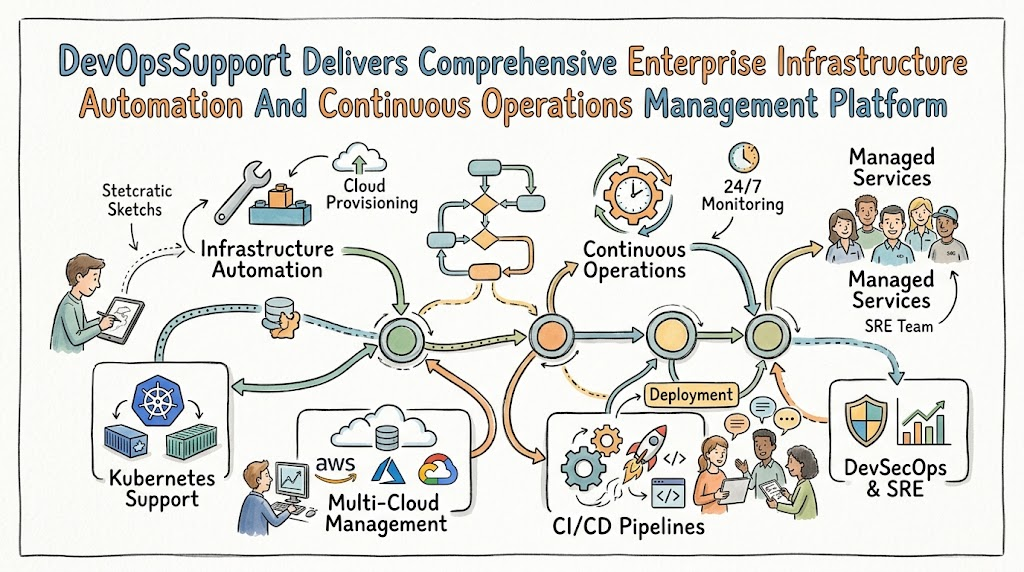
DevOpsSupport Delivers Comprehensive Enterprise Infrastructure Automation And Continuous Operations Management Platform
Introduction
Modern software development requires robust operational stability, rapid deployment pipelines, and continuous system reliability. Engineering teams often face significant challenges when managing complex cloud architectures while attempting to deliver product features quickly. Therefore, maintaining peak performance across multi-cloud environments demands dedicated technical expertise and continuous operational vigilance.DevOpsSupport offers specialized technical capabilities that bridge the gap between application development and scalable cloud operations. Consequently, organizations can eliminate continuous deployment bottlenecks while establishing proactive system maintenance. Furthermore, partnering with an experienced support team enables internal developers to focus entirely on core business features rather than firefighting unexpected production outages.
What Are DevOps Support Services?
DevOps Support Services encompass managed operational assistance, continuous infrastructure monitoring, automated pipeline maintenance, and cloud architecture optimization for modern digital enterprises. Furthermore, these technical offerings ensure that continuous integration and continuous delivery workflows function smoothly across all stage environments. Engineered solutions help prevent unexpected downtime through automated health checks, security patch management, and real-time incident resolution.Additionally, dedicated support engineers streamline complex cloud configurations, container orchestrations, and database performance tuning. Consequently, technical teams reduce operational drag and enhance release consistency without hiring massive internal operations departments. Ultimately, these services establish resilient delivery pipelines that adapt seamlessly to scaling business workloads.
Why DevOps Support Matters
System outages and sluggish deployment pipelines directly impact customer satisfaction and enterprise revenue. Furthermore, modern microservices architectures demand specialized knowledge across cloud providers, infrastructure tools, and security protocols. Without dedicated maintenance, technical debt accumulates rapidly, leading to fragile deployments and frequent production incidents.Therefore, expert technical assistance provides the foundation necessary for high-velocity software engineering. Additionally, ongoing architecture reviews prevent security vulnerabilities and reduce unnecessary cloud expenditure. Consequently, structured operational backing transforms infrastructure from a costly operational bottleneck into a competitive business advantage.
+-----------------------------------------------------------------------+
|                    DevOps Support Operational Core                    |
+-----------------------------------------------------------------------+
|  Proactive Infrastructure Monitoring  |  Continuous Pipeline Delivery  |
|  Real-Time Incident Resolution         |  Security & Compliance Checks |
+-----------------------------------------------------------------------+
24/7 DevOps Support Services: When Do They Make Sense?
Global enterprise applications operate continuously across multiple time zones, requiring uninterrupted system availability. Consequently, implementing 24/7 DevOps Support Services makes immediate sense for businesses managing mission-critical SaaS platforms, financial services, or high-traffic e-commerce systems. Proactive real-time monitoring detects subtle performance degradation long before it escalates into full-scale system downtime.Furthermore, on-demand incident response teams handle critical alerts immediately, maintaining system stability around the clock. Thus, engineering leadership avoids team burnout caused by midnight emergency pages. Ultimately, continuous oversight guarantees strict adherence to service level agreements while protecting organizational performance.
Managed DevOps Services vs Internal DevOps Operations
| Evaluation Dimension | Managed DevOps Services | Internal DevOps Team |
|---|---|---|
| Cost Efficiency | Predictable monthly cost without hiring overhead | High salary, recruitment, and retention costs |
| Skill Coverage | Diverse cross-platform specialists (AWS, Azure, K8s) | Limited to individual team member skill sets |
| Coverage Hours | Uninterrupted 24/7 operational monitoring | Typically limited to standard working hours |
| Scalability | Instant scaling up or down based on load | Slow hiring processes and onboarding delays |
Choosing Managed DevOps Services allows growing companies to access enterprise-grade engineering expertise at a fraction of standard recruiting costs. Conversely, building a fully in-house team requires significant time, extensive management bandwidth, and continuous training budgets.Furthermore, external specialists bring proven methodologies gathered from diverse industry environments. Consequently, teams can execute complex architectural migrations faster and with lower overall risk. Therefore, hybrid or fully managed approaches offer unmatched agility for dynamic software organizations.
What Should a Good DevOps Support Model Include?
A robust operational support model must address every stage of the software delivery life cycle. Therefore, effective frameworks integrate proactive system monitoring, structured incident handling, and continuous delivery optimization.
- Proactive Monitoring & Alerting: Real-time observability tracking CPU, memory, latency, and error rates.
- Automated CI/CD Operations: Streamlined delivery pipelines for continuous testing, building, and deployment.
- Infrastructure as Code (IaC): Standardized provisioning using modules from Terraform and Ansible.
- SLA-Backed Incident Response: Guaranteed response times backed by dedicated resolution workflows.
- Cost & Security Auditing: Regular operational reviews targeting security hardening and cloud cost savings.
DevOps Support Company India: What Should Businesses Evaluate?
Selecting a reliable DevOps Support Company India requires careful evaluation of technical capabilities, security standards, and operational maturity. India has established itself as a premier global technology hub, offering deep engineering talent and cost-effective operational continuity.Furthermore, global businesses must assess an agency's experience with multi-cloud architectures, container security, and regulatory compliance. Additionally, evaluating transparent communication protocols, documented escalation pathways, and real-world client testimonials guarantees a seamless long-term partnership. Consequently, choosing the right offshore partner ensures round-the-clock reliability and rapid deployment execution.
Kubernetes Support Services
Containerized applications require ongoing maintenance, security patch updates, and complex networking configurations. Through professional Kubernetes Support Services, engineering teams maintain stable cluster environments across public, private, and hybrid cloud infrastructures.
+-----------------------------------------------------------------------+
|                   Kubernetes Cluster Support Scope                    |
+-----------------------------------------------------------------------+
|  Node Autoscaling & Upgrades       |  Ingress & Service Mesh Control  |
|  RBAC & Network Security Policies  |  Stateful Workload Management    |
+-----------------------------------------------------------------------+
Specialists handle cluster upgrades, ingress controller setups, role-based access controls, and persistent storage management. Furthermore, expert troubleshooting resolves node failures, memory limits, and container crash loops rapidly. Consequently, businesses achieve seamless auto-scaling and high availability for microservice applications.
AWS DevOps Support Services
Managing Amazon Web Services infrastructure demands deep familiarity with cloud-native tooling and continuous optimization principles. With targeted AWS DevOps Support Services, organizations streamline workloads running on EKS, ECS, EC2, Lambda, and CloudFront.Additionally, specialists automate deployment workflows using Terraform and CloudFormation to enforce infrastructure consistency. Proactive monitoring via CloudWatch ensures immediate detection of system anomalies. Consequently, organizations maintain strict security compliance while reducing monthly cloud hosting expenses significantly.
Azure DevOps Support Services
Microsoft Azure environments require dedicated administration to ensure seamless pipeline execution and cloud resource security. Engaging specialized Azure DevOps Support Services helps organizations optimize Azure Pipelines, Azure Kubernetes Service (AKS), and Virtual Machine scale sets.Furthermore, certified cloud engineers manage artifact repositories, environment provisioning, and automated testing integrations. Consequently, enterprise teams reduce release friction while maintaining complete governance across hybrid enterprise environments. Therefore, structured management ensures continuous deployment safety and consistent workload performance.
DevSecOps Support Services
Integrating security directly into delivery pipelines prevents costly compliance breaches and software vulnerabilities. Specialized DevSecOps Support Services embed automated vulnerability scanning, static code analysis, and secrets management into every pull request.
[ Developer Commit ] ──> [ SAST / Dependency Scan ] ──> [ Secrets Audit ] ──> [ Secure Deployment ]Additionally, security engineers enforce container image scanning and compliance policies before production releases occur. Consequently, software teams build secure applications without slowing down deployment cadence. Ultimately, proactive security management builds trust with enterprise clients and regulatory authorities.
SRE Support Services
Site Reliability Engineering applies software engineering principles to solve complex operational and infrastructure challenges. Through comprehensive SRE Support Services, organizations define clear Service Level Indicators (SLIs) and Service Level Objectives (SLO).Furthermore, dedicated SRE engineers design resilient system architectures, manage incident post-mortems, and eliminate repetitive manual operational tasks. Consequently, system reliability improves continuously while failure rates drop across production systems. Therefore, organizations maintain high platform uptime during major traffic bursts.
MLOps Support Services
Deploying machine learning models into production requires continuous data pipeline oversight, model monitoring, and infrastructure scaling. Enterprise MLOps Support Services provide continuous backing for complex artificial intelligence workflows and automated training environments.Additionally, engineers manage feature stores, model registry pipelines, hardware accelerator allocation, and drift detection mechanisms. Consequently, data science teams publish models faster while maintaining consistent inference accuracy. Ultimately, managed support bridges the operational gap between statistical research and scalable software products.
A Practical Example of DevOps Support
Consider a rapidly growing SaaS enterprise experiencing frequent release failures during peak customer usage hours. Their internal developers spent over 30% of their weekly bandwidth manually debugging failed deployment pipelines and server configurations.After implementing structured support, dedicated engineers rebuilt their deployment architecture using automated Terraform scripts and Kubernetes auto-scaling. Furthermore, automated health checks and blue-green deployment strategies eliminated release downtime completely. Consequently, the company reduced production incidents by 75% while freeing internal developers to launch new product features faster.
How to Build a DevOps Support Strategy
Establishing a successful operational support strategy requires a step-by-step approach aligned with core business objectives.
Step 1: Audit Current Infrastructure & Identify Bottlenecks
  │
  ▼
Step 2: Define Key Performance Indicators (SLIs, SLOs, Maintenance SLAs)
  │
  ▼
Step 3: Automate Core Provisioning Using Infrastructure as Code
  │
  ▼
Step 4: Implement Centralized Logging, Observability, & Real-Time Alerting
  │
  ▼
Step 5: Review Architecture Continuously for Cost & Security Optimization- Infrastructure Audit: Evaluate existing build pipelines, cloud hosting setups, and security configurations.
- Metrics Definition: Standardize response times, recovery objectives, and deployment frequency goals.
- Pipeline Automation: Replace manual server setup steps with scriptable code modules.
- Observability Deployment: Establish real-time tracking across system logs, metrics, and error traces.
- Continuous Refinement: Perform monthly architectural reviews to optimize performance and reduce operational expenses.
How DevOps Support Can Reduce Operational Overhead
Unplanned system outages and inefficient cloud usage generate substantial financial drain for expanding digital businesses. External engineering assistance optimizes cloud resource allocation by terminating unused instances and right-sizing workloads.Additionally, automated provisioning eliminates labor-intensive manual deployment steps, reducing human error significantly. Consequently, engineering budgets shift from reactive problem-solving to proactive feature development. Therefore, managed operational backing delivers substantial long-term cost savings across technical departments.
When Should You Consider External DevOps Support?
- Internal software developers spend more time fixing server issues than writing application features.
- Frequent deployment failures cause service downtime during critical business hours.
- The company lacks specialized internal knowledge for container orchestration or multi-cloud security.
- Cloud infrastructure costs increase rapidly without clear visibility into usage metrics.
- Expanding customer bases demand 24/7 system availability and immediate incident resolution.
Why a Specialized Support Partner Can Help
Navigating complex cloud infrastructure requires deep technical experience and continuous learning across evolving toolchains. Partnering with a dedicated agency like DevOpsSupport provides immediate access to battle-tested engineers, mature operational frameworks, and robust SLA commitments.Furthermore, specialized partners implement industry best practices rapidly, avoiding common architectural missteps. Consequently, organizations achieve enterprise-grade stability, accelerated release cycles, and complete peace of mind. Ultimately, reliable support empowers modern businesses to scale their software products seamlessly.
Frequently Asked Questions About DevOpsSupport
- What services does DevOpsSupport provide for cloud infrastructure management?
DevOpsSupport offers cloud architecture design, automated CI/CD pipeline setup, continuous monitoring, security hardening, incident response, and cost optimization across major cloud platforms.
- How do 24/7 DevOps Support Services handle production emergency alerts?
Dedicated operational engineers monitor real-time system alerts continuously, acknowledge incidents immediately, and apply rapid remediation workflows to restore service stability instantly.
- Can small startups benefit from external Managed DevOps Services?
Yes, growing startups leverage external support to access specialized cloud engineering expertise without spending time and resources recruiting expensive full-time operations staff.
- What cloud providers are supported by your engineering team?
Our specialists manage infrastructures on Amazon Web Services, Microsoft Azure, Google Cloud Platform, DigitalOcean, and hybrid on-premises environments.
- How does DevOpsSupport help secure deployment pipelines?
We integrate automated code scanning, dependency vulnerability checks, container security tools, and encrypted secrets management directly into continuous integration workflows.
- What is included in Kubernetes Support Services?
Kubernetes assistance covers cluster setup, automated upgrades, node autoscaling, ingress controller configuration, security policy enforcement, and persistent storage management.
- How does Site Reliability Engineering improve overall system uptime?
SRE practices combine automated incident response, clear SLO tracking, proactive capacity planning, and post-mortem analysis to eliminate root causes of system failures.
- What engagement models are available for enterprise organizations?
Organizations can choose dedicated engineering resources, SLA-backed ticket response plans, project-based migration services, or continuous 24/7 operational coverage models.
- How long does it take to onboard an existing cloud infrastructure?
Standard onboarding typically takes a few business days, during which our team audits system architecture, sets up observability tools, and documents key deployment pipelines.
- How does MLOps support differ from standard DevOps services?
MLOps support specifically manages data pipeline automation, GPU allocation, machine learning model deployments, inference tracking, and performance drift monitoring.
Final Thoughts
Maintaining reliable, secure, and high-performing cloud infrastructure requires constant attention and specialized engineering capabilities. Organizations that invest in structured operational management eliminate release bottlenecks and protect application availability. Furthermore, leveraging dedicated expertise allows software development teams to dedicate their full energy toward building innovative products. Ultimately, partnering with an experienced support provider ensures continuous technical growth, operational stability, and enterprise success.
