Breaking Down the Path to Becoming a Certified DevOps Engineer
Introduction
Software delivery in the modern era demands a shift from manual intervention to high-velocity automation. The Certified DevOps Engineer program serves as a definitive blueprint for professionals eager to master this transition. By focusing on the intersection of culture and technology, this certification prepares you for high-stakes roles in Site Reliability Engineering and Platform Operations. DevOpsSchool delivers the rigorous training required to move beyond basic coding and into the realm of enterprise-scale infrastructure management. This guide clarifies the certification landscape, helping you choose a trajectory that maximizes your career impact and technical authority.
Understanding the Certified DevOps Engineer Standard
The Certified DevOps Engineer credential signifies a practitioner’s ability to orchestrate the entire software development lifecycle through persistent automation. It exists primarily to eliminate technical debt and bridge the communication gap between developers and IT operations teams. Unlike academic courses, this program emphasizes production-ready skills, forcing candidates to solve real-world problems involving deployment frequency and system stability. It aligns with the latest cloud-native methodologies, ensuring that you can maintain massive, distributed systems with minimal downtime and maximum efficiency.
Primary Candidates for This Certification
This career path specifically targets software developers, system administrators, and cloud architects who want to specialize in infrastructure automation. Site Reliability Engineers (SREs) benefit from the advanced monitoring modules, while security specialists find the DevSecOps integration vital for modern compliance. Managers and technical leads also gain the high-level perspective needed to steer digital transformation projects effectively. Because the demand for these skills spans from India’s tech hubs to global enterprises, this certification offers a universal language for engineering excellence.
The Enduring Value of Certification in the 2026 Landscape
As organizations adopt hybrid-cloud strategies, the need for engineers who can manage complex environments continues to grow. This certification remains valuable because it teaches fundamental principles—like idempotency and observability—that outlast specific tool versions. It provides a long-term career advantage, allowing you to adapt as the industry shifts from basic containers to sophisticated AI-driven operations. Ultimately, the time you invest translates into greater professional autonomy and the ability to command higher compensation in a competitive market.
Overview of the Certification Framework
The official curriculum resides at utilizes the DevOpsSchool hosting environment. Candidates navigate through various difficulty levels, starting with foundational tools and ending with complex architectural design. The program relies on project-based assessments rather than simple multiple-choice questions, ensuring that every certified professional can actually perform the required tasks. Industry veterans constantly update the content to reflect the newest trends in the CNCF (Cloud Native Computing Foundation) ecosystem.
Exploring Tracks and Progression Levels
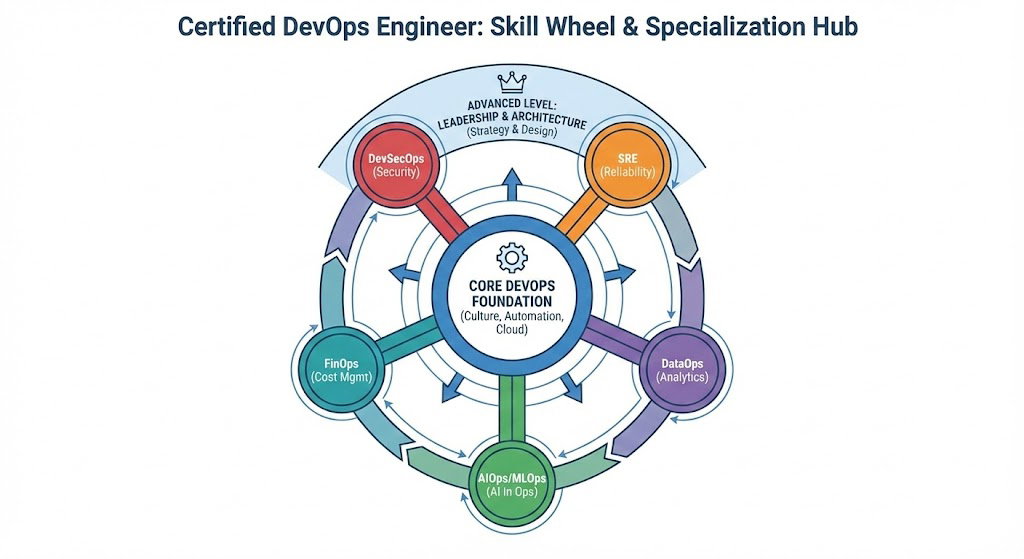
The curriculum breaks down into three distinct tiers: Foundation, Professional, and Advanced. The Foundation level builds your base in Linux and version control, while the Professional tier focuses on Kubernetes and Terraform. The Advanced tier allows for deep-specialization in areas like FinOps or DevSecOps. This layered approach ensures that you build a solid technical foundation before tackling the strategic complexities of leadership or specialized engineering roles.
Certified DevOps Engineer Comparison Table
| Track | Level | Ideal Audience | Necessary Skills | Core Competencies | Order |
| Core DevOps | Foundation | New Grads / Jrs | Basic OS Logic | Git, Shell, Docker | 1 |
| Core DevOps | Professional | Active Engineers | 2+ Years Exp | K8s, Terraform, CI/CD | 2 |
| Reliability | Advanced | SRE Specialists | Prof. Knowledge | Observability, SLAs | 3 |
| Security | Advanced | Security Leads | Prof. Knowledge | Vault, SAST/DAST | 3 |
| Cost Mgmt | Specialist | FinOps Leads | Cloud Basics | Cloud Billing, ROI | 4 |
Detailed Breakdown of Certification Levels
Certified DevOps Engineer – Foundation Level
What it isThis introductory tier validates your grasp of the DevOps philosophy and the basic command-line tools necessary for daily operations. It proves you can manage code repositories and navigate server environments with confidence.Who should take itAspiring engineers, manual testers, and traditional system admins should start here to modernize their technical profile.Skills you’ll gain
- Mastery of Git workflows and repository management.
- Command-line proficiency in Linux environments.
- Basic understanding of CI/CD pipeline construction.
- Skills in creating and managing Docker containers.
Real-world projects you should be able to do
- Create an automated build script for a simple application.
- Build a Docker image and deploy it to a local registry.
- Manage a collaborative project using Git branching strategies.
Preparation plan
- 7–14 days: Memorize core Linux commands and Git operations.
- 30 days: Experiment with basic Jenkins jobs and Dockerfiles.
- 60 days: Solve practice labs and build a simple end-to-end automation project.
Common mistakes
- Focusing only on tool syntax without learning the underlying "why."
- Skipping the fundamentals of networking and Linux permissions.
Best next certification after this
- Same-track option: Certified DevOps Engineer – Professional Level.
- Cross-track option: Entry-level Cloud Provider Certification (AWS/Azure).
- Leadership option: Agile Team Management Fundamentals.
Certified DevOps Engineer – Professional Level
What it isThe Professional level confirms your ability to architect and maintain complex automation ecosystems. It serves as the benchmark for a fully functional DevOps practitioner in a corporate setting.Who should take itEngineers with at least two years of experience who want to lead infrastructure projects and manage production clusters.Skills you’ll gain
- Expert-level Kubernetes orchestration and cluster hardening.
- Advanced Infrastructure as Code (IaC) using Terraform.
- Large-scale configuration management with Ansible.
- Implementation of advanced monitoring and logging stacks.
Real-world projects you should be able to do
- Provision a multi-region VPC using Terraform scripts.
- Deploy a microservices architecture on a managed Kubernetes service.
- Configure a self-healing system with automated alerts and scaling.
Preparation plan
- 7–14 days: Study advanced networking and YAML data structures.
- 30 days: Practice Kubernetes stateful sets and Terraform modules.
- 60 days: Integrate security scanning into a live production pipeline.
Common mistakes
- Neglecting to manage Terraform state files securely.
- Over-complicating pipelines with unnecessary third-party plugins.
Best next certification after this
- Same-track option: Certified DevOps Engineer – Advanced Level.
- Cross-track option: Certified DevSecOps Professional.
- Leadership option: DevOps Solutions Architect.
Specialized Career Path Options
DevOps Path
The standard DevOps track focuses on the core loop of software delivery. Engineers here master the speed of deployments and the reliability of the build process. You will spend your time optimizing Jenkins pipelines and managing container registries. This path offers the most job opportunities across every sector of the tech industry.
DevSecOps Path
This track prioritizes security at every stage of the development lifecycle. You will learn to automate vulnerability scans and manage encrypted secrets without disrupting the developer workflow. This path is perfect for those who want to defend enterprise infrastructure against modern cyber threats.
SRE Path
Site Reliability Engineering applies a software engineering mindset to IT operations problems. You will focus on maximizing system uptime and defining error budgets. This path is ideal for professionals who enjoy building resilient, self-healing systems that can handle massive traffic spikes.
AIOps / MLOps Path
This path bridges the gap between data science and operations. You will learn to manage the unique lifecycle of machine learning models, including data versioning and model monitoring. As AI becomes a staple in business, this track offers significant long-term growth potential.
DataOps Path
DataOps focuses on the delivery of high-quality data for analytics and business intelligence. You will apply DevOps principles to data pipelines, ensuring that information remains accurate and accessible. This role is crucial for data-driven organizations that require real-time insights.
FinOps Path
FinOps professionals manage the financial health of cloud deployments. You will work with finance teams to optimize spending and ensure that every dollar spent on cloud resources drives business value. This path is gaining massive traction as companies look to reduce cloud waste.
Mapping Roles to Certifications
| Professional Role | Recommended Certification Path |
| DevOps Engineer | Professional Level + Terraform Specialist |
| SRE | Advanced Level + Observability Expert |
| Platform Engineer | Kubernetes Administrator + Core DevOps |
| Cloud Engineer | Cloud Architect + Professional Level |
| Security Engineer | DevSecOps Specialist + Core DevOps |
| Data Engineer | DataOps Specialist + Cloud Practitioner |
| FinOps Practitioner | FinOps Certified + Cloud Specialist |
| Engineering Manager | DevOps Leader + Agile Certifications |
Advancing Your Credentials Post-Certification
Same Track Progression
Once you master the Professional level, you should pursue deep technical expertise in specific orchestration layers. Earning the Certified Kubernetes Administrator (CKA) or Security Specialist (CKS) credential makes you an indispensable asset for any cloud-native organization. Deep expertise ensures you can handle the most difficult architectural failures.
Cross-Track Expansion
Broadening your knowledge into security or financial management creates a "T-shaped" skill set. By understanding how security and costs impact the business, you move from being a "tool operator" to a "strategic partner." This makes you more competitive for senior roles in large-scale enterprises.
Leadership & Management Track
For those aiming for executive roles, the DevOps Leader track offers the best transition. You will shift your focus from writing scripts to designing team structures and cultural frameworks. This path prepares you to lead entire engineering departments through complex organizational changes.
Recommended Training Providers
DevOpsSchool
DevOpsSchool offers a massive library of lab-based courses that focus on practical, hands-on learning. Their instructors update the curriculum weekly to include the latest industry changes, ensuring you learn only the most relevant skills.
Cotocus
Cotocus specializes in enterprise-level training and consulting. They excel at helping teams transition to modern DevOps workflows through customized workshops and deep-dive technical sessions.
Scmgalaxy
Scmgalaxy provides a comprehensive repository of tutorials and community support for configuration management. It remains an essential resource for engineers looking to troubleshoot specific technical challenges in real-time.
BestDevOps
BestDevOps creates highly focused training tracks that target the most in-demand industry tools. Their approach emphasizes the rapid creation of production-grade CI/CD pipelines and automated infrastructure.
This platform focuses strictly on the intersection of security and automation. They provide the deep technical knowledge required to secure high-speed delivery pipelines in regulated industries.
Sreschool.com focuses on the principles of reliability and system health. Their training covers everything from designing service level objectives to managing high-pressure incident responses.
Aiopsschool.com leads the way in teaching engineers how to apply AI to operational tasks. You will learn to use machine learning for predictive maintenance and automated root-cause analysis.
Dataopsschool.com applies the rigor of DevOps to data management. Their certifications ensure that your data pipelines remain agile, reliable, and scalable.
finopsschool.com
Finopsschool.com teaches the technical and financial skills required to manage cloud costs. This provider is the top choice for engineers looking to master the business side of the cloud.
General Frequently Asked Questions
- How difficult is the Certified DevOps Engineer exam?The exam is moderately hard because it tests your ability to solve practical problems rather than just memorizing facts.
- How long does it take to get certified?Most students finish the training and pass the exam in about 60 to 90 days of consistent study.
- Do I need a degree to take this certification?No, while a technical background helps, your ability to complete the hands-on labs matters more than your formal education.
- What is the financial return on this certification?Certified engineers typically command significantly higher salaries and receive more interest from top-tier tech recruiters.
- What is the best order to take these courses?Start with the Foundation level, advance to the Professional level, and then pick a specialty like SRE or DevSecOps.
- Does this certification expire?Yes, you should recertify every two or three years to ensure your skills stay current with new technology.
- Does it focus on AWS, Azure, or Google Cloud?The curriculum remains cloud-agnostic, focusing on universal tools like Kubernetes and Terraform that work everywhere.
- Can I take the exam from home?Yes, you can take proctored exams online from anywhere in the world.
- What specific job titles can I apply for?You will be ready for roles like DevOps Engineer, Cloud Architect, and Automation Lead.
- How does this differ from tool-specific certs?This program teaches the complete workflow and integration of multiple tools, whereas tool-specific certs only focus on one product.
- Is there a place to ask questions during study?Yes, communities like Scmgalaxy offer forums where you can interact with experts and other students.
- Are there labs included in the training fee?Yes, the training includes access to virtual labs where you can practice without paying for cloud resources.
Focused FAQs on Certified DevOps Engineer
The Certified DevOps Engineer program sets itself apart by demanding a high level of technical competency across multiple domains. It forces you to think about how code behaves in a production environment, not just how it looks on a developer's screen. By mastering the integration of tools like Jenkins, Docker, and Kubernetes, you prove that you can handle the complexities of a modern software company. This certification gives you the authority to lead technical discussions and implement the changes necessary to keep a business competitive in a digital-first world.
Final Thoughts: Is the Investment Worth It?
As a mentor with decades of experience, I see many engineers chase trends while ignoring the fundamentals. This certification does the opposite; it grounds you in the core principles of automation and reliability while giving you the tools to succeed today. If you want to stop being a "firefighter" who manually fixes servers and start being an architect who builds systems, this path is for you. The work is hard, the labs are challenging, but the career growth and personal satisfaction are immense.
