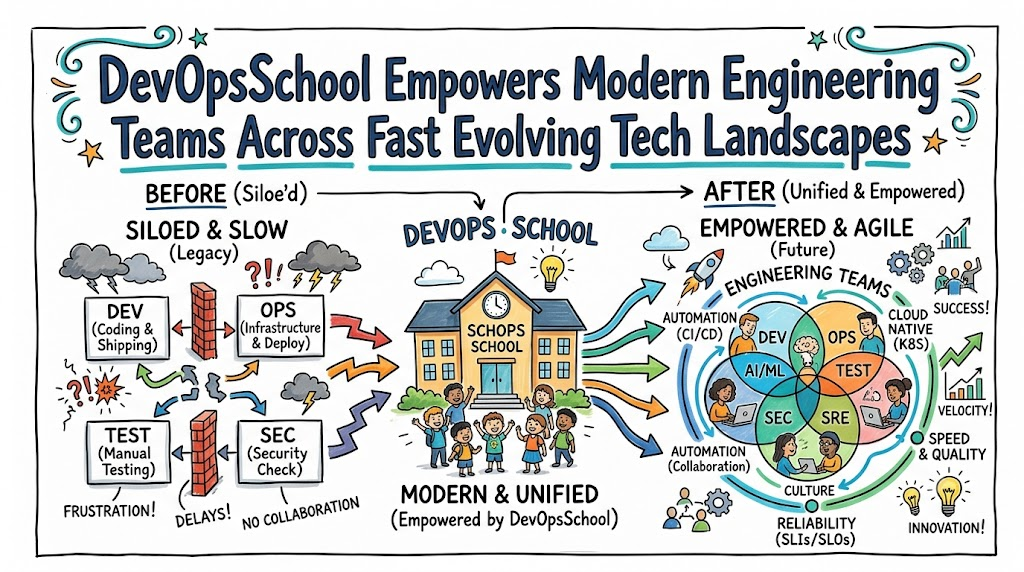
DevOpsSchool Empowers Modern Engineering Teams Across Fast Evolving Tech Landscapes
Introduction
Software development moves rapidly today, and technical teams must ship code faster without causing system crashes. Modern businesses face intense pressure to deliver reliable digital services, yet traditional development cycles often create communication silos between software developers and IT operations staff.Consequently, engineers struggle with slow deployments, unexpected production downtime, and manual server configurations. In this comprehensive guide, we will unpack how modern automation practices solve these challenges. We explore hands-on workflows, proven architectural patterns, real production case studies, and structured technical pathways that help engineers bridge theoretical knowledge with enterprise production stability.
What Is DevOps and Why Does It Matter Today?
DevOps represents an engineering methodology that unites software construction and IT operations through shared accountability, automated toolchains, and continuous feedback. Instead of treating testing and deployment as separate milestones, engineering teams collaborate seamlessly across the complete software delivery cycle.Furthermore, industry benchmarks show that high-performing engineering teams deploy code forty times faster than their competitors. These teams also achieve one-fifth the change failure rate because automated guardrails catch regression bugs early. Modern organizations adopt this mindset to deliver customer value rapidly while maintaining strict enterprise compliance.
Core Components of a Modern DevOps Environment
A resilient engineering environment depends on several interconnected pillars that eliminate human error. Teams achieve operational excellence when they combine disciplined collaboration with automated tooling across the development lifecycle.
- Version Control: Centralized systems like Git track incremental code changes and manage parallel feature branches.
- Continuous Integration: Automated build engines compile code and run unit test suites on every commit.
- Continuous Deployment: Deployment pipelines push verified code artifacts directly to production without manual gatekeeping.
- Infrastructure Automation: Declarative configuration scripts provision cloud compute, network topologies, and storage volumes.
- Telemetry and Monitoring: Real-time dashboards track application latency, throughput, error rates, and CPU utilization.
How CI/CD Improves Software Delivery
Continuous Integration and Continuous Deployment (CI/CD) pipelines replace unpredictable quarterly releases with small, routine updates. Automated pipelines evaluate code quality against strict linting rules and integration suites within minutes of a developer commit.As an engineer on our production team recently observed during a major retail migration, automated canary releases prevented an outage during peak traffic. The automated deployment system detected elevated error rates on a two-percent user sample and automatically rolled back the release before customer checkout journeys suffered.
Step 1: Code Commit --> Step 2: Automated Build --> Step 3: Security Scan --> Step 4: Integration Tests --> Step 5: Automated DeploymentWhy Infrastructure as Code Matters
Infrastructure as Code (IaC) treats servers, virtual firewalls, and subnets as programmable software assets. Engineers define their system architecture using declarative code repositories rather than clicking buttons inside cloud management consoles.As a result, operations teams eliminate environment drift between development and production environments. When an infrastructure failure happens, engineers re-provision identical environments across alternative regions in minutes, maintaining business continuity.
| Infrastructure Pattern | Traditional Manual Setup | Infrastructure as Code |
|---|---|---|
| Provisioning Speed | Days or weeks via service tickets | Minutes via automated scripts |
| Configuration Consistency | Frequent manual drift and discrepancies | Strictly identical environments |
| Audit Trails | Undocumented manual console changes | Full Git commit change history |
| Disaster Recovery | High recovery time objective | Instant multi-region reproduction |
Containers and Kubernetes in Modern Engineering
Containers package application runtimes with dependencies, allowing software to execute identically on local laptops and production servers. Lightweight containers decouple application logic from underlying operating systems, saving compute overhead.However, running hundreds of microservice containers in production requires intelligent orchestration. Modern systems leverage Kubernetes to schedule workloads, manage service discovery, and automate container rollouts. Through specialized Kubernetes Training China, engineers learn to balance cluster resources, implement GitOps workflows, and secure multi-tenant clusters effectively.
Understanding Site Reliability Engineering
Site Reliability Engineering (SRE) applies software engineering principles to operations problems. Instead of treating outages as moral failures, SRE teams implement measurable Service Level Indicators (SLIs) and Service Level Objectives (SLOs) to guide release velocity.Moreover, our SRE Training China programs teach teams how to establish data-driven error budgets. When systems perform reliably within their error budget, product teams release new features aggressively. Conversely, when error budgets exhaust, engineering teams pause feature deployments and focus entirely on system hardening.
Bringing Security Into the Development Lifecycle
Traditional security reviews at the end of a release cycle often delay critical software launches. DevSecOps shifts vulnerability management earlier into local development environments and automated pipelines.Therefore, our DevSecOps Training China curriculum teaches developers how to run static code analysis, manage container vulnerabilities, and detect hardcoded secrets automatically. Embedding policy-as-code into delivery pipelines ensures software updates remain compliant with international security frameworks without stalling development velocity.
Cloud Computing and Modern Infrastructure
Cloud platforms provide scalable virtual resources on demand, freeing enterprises from physical datacenter maintenance. Modern engineers build elastic backends that scale down during idle hours to optimize monthly infrastructure expenditure.Through hands-on Cloud Computing Training China, professionals master distributed design patterns across AWS, Azure, and Google Cloud Platform. Engineers build resilient multi-region architectures, implement secure network topologies, and configure automated data lifecycle policies across hybrid environments.
Platform Engineering and Developer Experience
As microservice architectures expand, enterprise developers often spend excessive time configuring deployment pipelines and cloud infrastructure instead of writing business logic. Platform engineering addresses this issue by constructing self-service Internal Developer Platforms (IDPs).Additionally, structured Platform Engineering Training China demonstrates how platform teams create clear "golden paths" for developers. These self-service portals allow feature teams to spin up compliant environments, databases, and continuous delivery pipelines with minimal operational friction.
The Rise of MLOps
Machine learning models behave differently from traditional software because their output quality depends directly on shifting production data patterns. Machine learning operations (MLOps) establishes disciplined engineering practices around model retraining, tracking, and serving.For this reason, our specialized MLOps Training China prepares engineers to automate feature stores, schedule pipeline retraining, and run inference models on Kubernetes clusters. Engineering teams monitor data drift continuously, preventing degraded predictive models from harming customer experience.
Building an Effective DevOps Learning Roadmap
Mastering modern infrastructure requires a structured progression through core engineering disciplines. Learners often feel overwhelmed when attempting to learn every cloud tool at once without building foundational skills first.
- Operating Systems & Scripting: Master Linux administration, Bash automation, and Python programming.
- Version Control & Collaboration: Practice branch protection rules, code reviews, and Git rebasing.
- Continuous Integration & Delivery: Build automated build pipelines using Jenkins and modern runners.
- Containerization & Orchestration: Package applications into Docker images and deploy multi-tier Kubernetes pods.
- Infrastructure as Code: Automate cloud resources using Terraform modules and configuration management.
- Observability & Reliability: Set up log aggregation, distributed tracing, and Prometheus alerting.
Individual Learning vs Enterprise Training
Individual engineers frequently learn through trial-and-error documentation and isolated sandbox environments. While this self-directed approach provides basic familiarity, it often misses complex production constraints such as compliance policies and multi-tenant security.In contrast, customized Corporate DevOps Training China aligns engineering cohorts around an organization's specific tech stack. Teams practice deployment incident simulations, refactor legacy microservices, and adopt unified engineering standards, accelerating enterprise transformation initiatives.
When Organizations Need DevOps Consulting
Enterprise technology modernization requires structural organizational adjustments alongside new tooling adoption. When internal teams face recurring deployment bottlenecks or architectural confusion, outside expertise provides clarity.Engaging our DevOps Consulting China services helps companies assess their operational maturity and design scalable platform architectures. Expert consultants identify delivery pipeline inefficiencies, automate compliance guardrails, and train staff on high-performance operational habits.
How to Choose the Right DevOps Training Program
Selecting a professional development program requires assessing the practical engineering depth of the curriculum. Theoretical slide decks do not prepare engineers for production outages, data corruptions, or broken build pipelines.Consequently, prospective students should look for programs that provide dedicated, live lab environments with real-world troubleshooting scenarios. Top-tier educational offerings provide direct mentorship from active industry practitioners who teach production incident handling.
Common Mistakes When Learning DevOps
Many engineers focus solely on collecting software certifications without mastering underlying system mechanics. They memorize complex commands but struggle to troubleshoot broken network routes or investigate high server load.
- Tool Obsession: Focusing on tools rather than underlying software delivery methodologies.
- Ignoring Fundamentals: Skipping Linux networking, file permissions, and storage basics.
- Neglecting Security: Writing insecure infrastructure scripts that leak credentials into public repositories.
- Bypassing Testing: Pushing code directly to production without automated unit and integration tests.
Practical Skills That Matter in Production
Production engineering requires diagnostic composure under system failure conditions. High-performing engineers trace network packets, analyze core dumps, and isolate memory leaks across distributed clusters during active incidents.Furthermore, engineers must communicate clearly during critical outages. System operators who translate technical failures into business impact metrics earn leadership trust and manage incident mitigation effectively.
DevOps Career Opportunities in China
China's thriving technology ecosystem creates sustained demand for engineers proficient in cloud automation, microservices, and cluster scalability. Large enterprises across e-commerce, electric vehicles, and financial technology seek talent that balances deployment speed with platform reliability.As enterprise infrastructure expands, certified professionals command significant career advantages. Achieving an industry-recognized DevOps Certification China credential proves an engineer can manage scalable delivery infrastructure under enterprise conditions.
Why Practical Learning Is Important
Technical documentation frequently presents happy-path deployment scenarios where dependencies install cleanly and network requests succeed instantly. However, real-world production environments introduce legacy systems, network latency, and restrictive enterprise proxies.Therefore, hands-on lab exercises teach engineers how to resolve subtle configuration errors, debug distributed microservices, and restore corrupted databases under pressure. Experiential practice builds the technical muscle memory required for operational excellence.
DevOpsSchool Learning With a Practical Focus
DevOpsSchool provides comprehensive educational programs designed by seasoned industry architects who solve complex infrastructure problems daily. Students work inside live sandbox cloud environments, implementing production-grade infrastructure topologies from scratch.Moreover, our structured DevOps Training China tracks prepare engineers to modernize systems, automate manual toil, and accelerate delivery pipelines. Learners gain the hands-on engineering capabilities necessary to lead digital transformation projects across global enterprises.
Frequently Asked Questions About DevOpsSchool
- What prerequisites do I need before joining a DevOps program?
You need foundational familiarity with basic computer networking concepts and standard Linux operating system commands. Scripting experience in Bash or Python is beneficial, but introductory modules cover essential coding patterns thoroughly.
- How does practical lab work function during the training modules?
Students receive dedicated cloud environments to build, break, and repair production systems. You will execute automated deployment scripts, configure monitoring agents, and troubleshoot simulated cluster crashes directly on live servers.
- Are the training programs aligned with enterprise hiring expectations?
Yes, the curriculum mirrors modern engineering challenges found across top technology organizations. Course projects require you to build complete CI/CD pipelines, containerized clusters, and secure cloud topologies from scratch.
- Can working professionals balance the study schedule with their jobs?
Our flexible weekend cohorts and modular evening tracks accommodate busy work schedules. Recorded sessions, lab documentation, and instructor office hours remain accessible throughout the learning journey.
- How does SRE training differ from standard DevOps training modules?
Standard DevOps modules focus primarily on continuous delivery pipelines and infrastructure provisioning. SRE modules prioritize operational reliability, metrics collection, error budgets, distributed tracing, and incident post-mortem methodologies.
- What security topics are covered within the DevSecOps curriculum?
The DevSecOps track covers static and dynamic code scanning, container vulnerability management, secrets protection, and automated compliance policies. Students learn to embed automated security gates directly into deployment pipelines.
- How does Platform Engineering improve day-to-day developer productivity?
Platform engineering reduces cognitive overload for feature developers by providing pre-configured deployment templates and self-service cloud infrastructure. This automation eliminates manual ticket requests for development servers.
- Does the MLOps track cover deep learning model deployment?
Yes, the course demonstrates packaging machine learning models inside containers and deploying them to Kubernetes clusters. You will learn to build automated retraining workflows and monitor live data drift.
- How do corporate training engagements adapt to proprietary tech stacks?
We assess your engineering department's current workflows, internal tooling, and transformation goals beforehand. We then customize lab exercises around your company's specific deployment environments and tech stacks.
- What value does an industry certification provide to an engineer?
Certifications validate that your technical skills meet recognized industry standards for production management. They demonstrate your ability to automate pipelines, secure systems, and manage high-availability cloud infrastructure.
Final Thoughts
Modern software delivery demands automation, collaboration, and scalable cloud engineering. By adopting modern DevOps, SRE, and platform engineering practices, technical professionals transform into strategic engineering leaders who deliver reliable software systems at scale.
