Complete Guide to Modern Security Automation with DevSecOpsSchool Programs
Introduction
Modern software engineering moves faster than ever before, yet rapid deployment often introduces critical vulnerabilities. Therefore, organizations must shift security left rather than treating audits as a final gatekeeper. When teams integrate automated controls early, they prevent expensive breaches and accelerate delivery cycles.Practical hands-on practice builds real technical confidence. Through structured programs, engineers master pipeline automation, infrastructure scanning, and runtime protection directly in real lab environments. This guide breaks down the essential architectural components, strategic best practices, and actionable learning paths needed to secure cloud-native environments.
What Is DevSecOps?
DevSecOps represents the natural evolution of agile engineering, bringing development, operations, and security into a single continuous delivery model. Instead of relying on manual security reviews at the end of a sprint, teams embed automated checks into every commit, build, and deployment.Consequently, security becomes a shared responsibility across the entire delivery team. Developers actively write secure code, operations engineers maintain hardened infrastructure, and security specialists build scalable guardrails. This holistic approach ensures software ships fast without sacrificing reliability or compliance standards.
Why DevSecOps Matters for Modern Engineering Teams
Traditional perimeter defense mechanisms can no longer protect dynamic multi-cloud deployments and microservices architectures. Furthermore, industry data shows that remediating security defects in production costs up to thirty times more than catching them during early design and coding phases.Automating security checks fundamentally eliminates deployment bottlenecks and safeguards brand reputation. When engineering teams build automated feedback loops, they spot configuration drift and exposed secrets instantly. Thus, companies achieve high deployment frequency while maintaining a resilient, defensible enterprise footprint.
Core Components of a DevSecOps Program
A mature security automation initiative rests on several foundational pillars that span the entire development lifecycle:
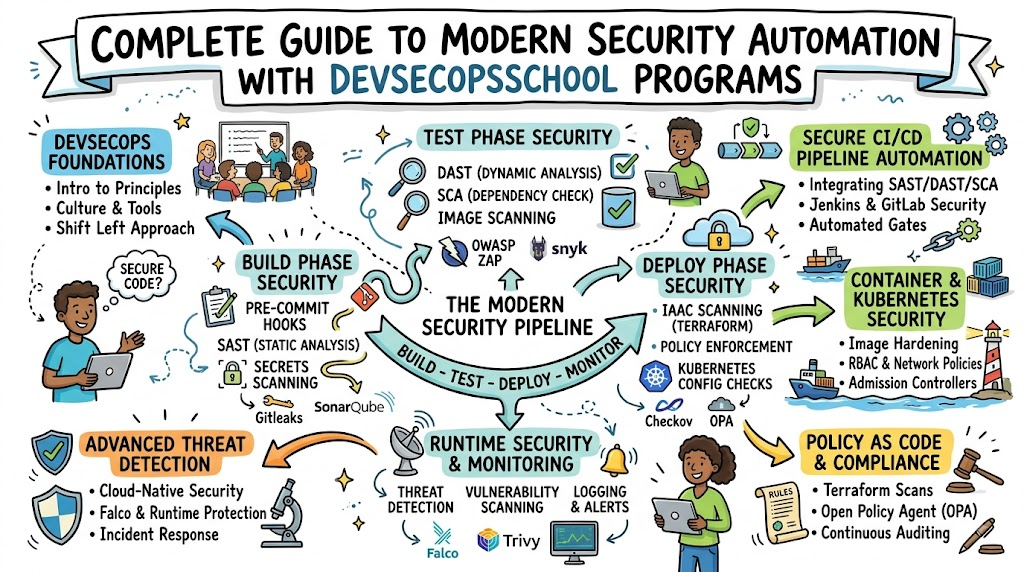
- Static Application Security Testing (SAST): Scans source code repositories continuously to detect code-level weaknesses before compilation.
- Software Composition Analysis (SCA): Analyzes third-party dependencies and open-source packages to identify known CVE vulnerabilities and license risks.
- Dynamic Application Security Testing (DAST): Tests running applications against real-world attack vectors in staging environments.
- Secrets Management: Secures API tokens, SSH keys, and database credentials using centralized, ephemeral vaults.
- Infrastructure as Code (IaC) Scanning: Evaluates deployment templates against security benchmarks before provisioning cloud resources.
Security in CI/CD Pipelines
Continuous integration pipelines serve as the primary enforcement layer for automated security policies. Therefore, engineers must embed non-blocking scanners directly into build stages so developers receive instant feedback on pull requests.
| Pipeline Phase | Primary Security Objective | Recommended Tooling Types |
|---|---|---|
| Commit & Build | Pre-commit hooks, secret detection, SAST | Semgrep, SonarQube, Gitleaks |
| Artifact Packaging | Container image vulnerability and SBOM analysis | Trivy, Grype |
| Staging Deployment | Dynamic runtime testing and API fuzzing | OWASP ZAP, Postman Security |
| Production Release | Continuous policy validation and admission checks | Open Policy Agent, HashiCorp Vault |
By standardizing these automated pipeline checks, teams detect broken access controls and vulnerable dependencies before software ever reaches production clusters.
Policy as Code
Manual security sign-offs cannot scale alongside automated deployment pipelines. In contrast, Policy as Code codifies governance rules, organizational policies, and compliance mandates directly into version-controlled files.As a result, engines like Open Policy Agent evaluate configuration files and pull requests programmatically. For instance, a policy can automatically block any container running with root privileges or deny S3 buckets created without default encryption. This creates predictable, auditable compliance across all environments.
Kubernetes Security
Container orchestration introduces unique operational layers that require dedicated defense-in-depth strategies. Securing clusters demands strict access governance, automated image inspection, and continuous runtime observability.
+-------------------------------------------------------------+
|                 KUBERNETES DEFENSE IN DEPTH                 |
+-------------------------------------------------------------+
|  [ Cluster Access ]  --> Strict RBAC & TLS Mutual Auth      |
|  [ Admission Gate ]  --> Kyverno / OPA Policy Validation    |
|  [ Pod & Network  ]  --> Calico Network Policies & Non-Root |
|  [ Runtime Shield ]  --> Falco Kernel-Level Threat Scans    |
+-------------------------------------------------------------+
Moreover, implementing targeted Kubernetes Security Training equips infrastructure engineers with the tactical skills required to configure admission webhooks, enforce mutual TLS, and isolate compromised workloads swiftly.
Cloud Security and DevSecOps
Cloud environments change dynamically, requiring continuous posture management rather than static quarterly reviews. Cloud security teams must enforce least-privilege identity access management policies while monitoring multi-cloud infrastructure for unintended drift.Additionally, integrating automated compliance scanners allows teams to validate cloud assets against CIS Benchmarks consistently. This continuous feedback loop ensures development velocity remains high without inadvertently exposing storage buckets or management ports to the public internet.
Vulnerability Management
Effective vulnerability management prioritizes actionable risk mitigation over noisy alerts. Because modern applications pull hundreds of dependencies, security systems must correlate exploitability metrics, reachable code paths, and business context.Teams should establish clear service level agreements for patching critical vulnerabilities promptly. By automating patch testing in staging pipelines, engineers apply updates rapidly without destabilizing core business operations.
Compliance Automation
Traditional compliance audits involve tedious manual evidence gathering, spreadsheets, and stressful review meetings. Conversely, compliance automation replaces manual checks by continuously assessing infrastructure state against frameworks such as SOC 2, ISO 27001, and PCI-DSS.Every configuration change produces verifiable audit logs automatically. Consequently, engineering teams spend significantly less time preparing audit evidence while leadership maintains verifiable proof of continuous regulatory adherence.
Building a DevSecOps Culture
Tools alone cannot secure an organization if development, operations, and security teams work in disconnected silos. Successful transformation requires fostering psychological safety, collaborative problem-solving, and a thriving Security Champions network.Security champions act as embedded advocates within development squads, bridging technical knowledge gaps and mentoring peers. When leaders reward secure design decisions rather than penalizing discovery of bugs, engineering velocity and platform stability increase in parallel.
Common DevSecOps Mistakes
Many organizations struggle during implementation by attempting too many sweeping changes at once. Recognizing common implementation anti-patterns helps engineering leaders avoid costly delays:
- Running Scanners with Default Alert Noise: Flooding developers with thousands of false positives causes alert fatigue and delays genuine fixes.
- Blocking Builds Too Early: Breaking deployment pipelines before teams understand how to resolve findings stalls development progress.
- Neglecting Internal Secrets Storage: Storing unencrypted credentials in repository history remains one of the most common vectors for enterprise data leaks.
- Treating Training as a One-Time Event: Failing to provide ongoing hands-on skill development leads to tool misuse and inconsistent security postures.
How DevSecOps Training Can Help
Navigating complex security frameworks requires structured, hands-on guidance from industry practitioners. A well-designed DevSecOps Course bridges theoretical concepts and enterprise implementations through real-world labs.Engineers learn how to build automated pipelines, write custom detection policies, and harden live container clusters. Consequently, practical DevSecOps Training accelerates team proficiency, lowers operational risk, and empowers engineers to architect defensible enterprise platforms.
Who Can Benefit From DevSecOps Learning?
Security automation skills are essential across multiple technical roles within modern digital organizations:
- Software Developers: Learn to write defensive code, remediate open-source vulnerabilities, and automate unit security testing.
- DevOps & Platform Engineers: Master pipeline integration, secrets management systems, and automated IaC policy scanning.
- Cybersecurity Analysts: Transition from manual testing to building automated security controls across cloud-native environments.
- Solutions Architects & Engineering Leads: Design scalable, compliant architectures while leading organizational cultural shifts.
DevSecOps Online Training
Distributed engineering teams require flexible, high-impact learning solutions that fit demanding production schedules. Enrolling in structured DevSecOps Online Training gives professionals access to live interactive sessions, on-demand lab environments, and expert mentorship from anywhere in the world.Furthermore, remote lab exercises simulate realistic enterprise incidents, such as container breakouts and pipeline poisoning. Learners troubleshoot these scenarios in isolated sandboxes, gaining practical operational experience that applies immediately to workplace environments.
DevSecOps Training in India
India continues to serve as a premier global hub for software development, cloud operations, and enterprise digital transformation. As companies rapidly modernize their application suites, the demand for DevSecOps Training in India has grown exponentially across both enterprise teams and individual professionals.Engaging with regional programs provides engineering teams with structured curricula aligned with global enterprise standards. These specialized programs prepare professionals to address complex international compliance requirements while optimizing large-scale engineering delivery ecosystems.
DevSecOps Engineer Certification
Validating technical expertise through recognized credentials helps professionals stand out in a competitive engineering market. Achieving a specialized DevSecOps Engineer Certification proves that a practitioner possesses deep skills in building automated security pipelines and hardening cloud infrastructure.Candidates demonstrate practical competence in configuring static analysis tools, orchestrating secrets management, and implementing admission controllers. This credential signals to employers that the holder can immediately lead security automation projects.
Becoming a Certified DevSecOps Professional
Advancing to the level of a Certified DevSecOps Professional represents complete mastery over enterprise-grade security architecture. This milestone signifies that an engineer can design end-to-end security architectures across multi-cloud environments, container orchestrators, and automated delivery platforms.Certified professionals excel at aligning technical safeguards with broader business compliance objectives. They drive automation initiatives, mentor junior engineers, and design resilient systems capable of withstanding sophisticated modern cyber threats.
Choosing the Right DevSecOps Learning Program
Selecting the ideal educational path depends on current technical skills, organizational objectives, and career goals:
| Career Objective | Recommended Educational Path | Primary Learning Focus |
|---|---|---|
| Enterprise Transformation | Corporate DevSecOps Training | Team alignment, standardized pipeline baselines, culture |
| Role Specialization | DevSecOps Certification Training | SAST/DAST automation, policy as code, cloud security |
| Cluster Defense Mastery | Kubernetes Security Training | RBAC, network policies, runtime monitoring, admission control |
| Career Advancement | DevSecOps Certification programs | End-to-end architecture, compliance auditing, toolchain mastery |
Focusing on programs with hands-on lab environments ensures that every hour invested translates directly into practical engineering capability.
DevSecOpsSchool's Practical Learning Approach
Enterprise technical competence requires active experimentation rather than passive video lectures. Therefore, DevSecOpsSchool programs emphasize lab-driven instruction where students build, secure, break, and remediate realistic applications.Learners configure comprehensive pipelines utilizing tools like Jenkins, GitHub Actions, SonarQube, Trivy, and HashiCorp Vault. In addition, organizations benefit from customized Corporate DevSecOps Training programs tailored directly to their internal technology stacks, accelerating organizational maturity and securing business-critical assets.
Frequently Asked Questions About DevSecOpsSchool
- What core prerequisites are recommended before starting the courses?Learners should possess a foundational understanding of Linux administration, basic scripting skills, and standard DevOps concepts like containerization and CI/CD pipelines.
- How do hands-on lab exercises work during the training?Students receive dedicated cloud sandbox environments pre-configured with industry-standard security tools, source code repositories, and broken pipelines to repair.
- Does the curriculum cover major public cloud platforms?Yes, the training incorporates practical security configurations, identity management, and policy enforcement across Amazon Web Services, Microsoft Azure, and Google Cloud Platform.
- How does this program support container and Kubernetes security?The courses feature extensive modules covering image scanning, secret distribution, admission control policies, network isolation, and runtime protection for production clusters.
- Can enterprises customize the syllabus for internal teams?Enterprise training programs offer tailored curricula designed to align directly with an organization's specific toolchains, cloud providers, and compliance frameworks.
- What automated scanning tools are included in the labs?Learners gain direct operational experience with tools such as SonarQube, Semgrep, OWASP ZAP, Trivy, Checkov, Open Policy Agent, and HashiCorp Vault.
- How does earning a certification benefit career progression?Achieving industry-recognized credentials verifies your practical ability to secure pipelines and infrastructure, making you a strong candidate for senior engineering roles.
- Are the training sessions conducted live or self-paced?Programs offer interactive, instructor-led sessions supplemented by recorded materials, comprehensive documentation, and ongoing access to practice lab environments.
- How is Policy as Code taught within the curriculum?Students write, test, and enforce automated policies using Open Policy Agent and Rego to validate Kubernetes manifests and Infrastructure as Code templates.
- What post-training support and mentoring options are available?Graduates receive ongoing access to community forums, updated course documentation, and technical guidance to help solve challenging real-world deployment scenarios.
Final Thoughts
Transitioning to automated security requires uniting disciplined engineering practices, automated tooling, and collaborative organizational culture. When engineering teams shift security left, they eliminate deployment bottlenecks, prevent costly breaches, and ship robust software with confidence.Investing in structured, lab-driven education equips practitioners and enterprise teams with the practical capabilities needed to secure modern infrastructure. By mastering continuous scanning, policy as code, and cluster hardening, engineers build resilient delivery pipelines that protect organizational assets and accelerate business innovation.
