Complete Guide to AWS Certified DevOps Engineer Professional
Introduction
Modern enterprise engineering requires resilient automation, rock-solid governance, and scalable continuous delivery across multi-account architectures. The AWS Certified DevOps Engineer Professional stands out as a premier credential validating high-level technical capability on Amazon Web Services. This comprehensive guide is built for practicing systems engineers, platform specialists, site reliability engineers, and engineering managers aiming to validate complex cloud operations. Industry training ecosystems like DevOpsSchool provide structured paths to help professionals navigate this certification. By understanding the core exam domains, prerequisite knowledge, real-world deployment patterns, and operational responsibilities, you can make informed decisions to advance your platform engineering career.
What is the AWS Certified DevOps Engineer Professional?
The AWS Certified DevOps Engineer Professional credential represents mastery in automating, provisioning, operating, and managing distributed cloud applications on AWS. It validates that an engineer understands both continuous integration and delivery pipelines alongside deep systems reliability and governance. This certification does not test simple terminology or basic console navigation; rather, it demands thorough understanding of production-grade architectural decision-making.In practical engineering environments, this qualification bridges the gap between raw infrastructure provisioning and sustained release velocity. Candidates must prove their ability to configure immutable deployments, design cross-account security guardrails, automate multi-region incident responses, and implement resilient monitoring topologies. It directly reflects the standard operating procedures of enterprise engineering groups running zero-downtime microservices.
Who Should Pursue AWS Certified DevOps Engineer Professional?
This credential caters to technical professionals with existing hands-on cloud exposure who want to demonstrate mastery of modern automation. Mid-level and senior DevOps engineers, Site Reliability Engineers (SREs), systems administrators, platform engineers, and cloud architects benefit significantly from the rigorous testing scope. Software engineers transitioning into full-lifecycle ownership of infrastructure and deployment systems will find it equally relevant.Experienced individual contributors gain formal industry validation that accelerates progression into staff, principal, or lead infrastructure engineering roles. Engineering managers, technical delivery heads, and enterprise practice leads also pursue it to acquire the technical depth required to evaluate tooling architectures, enforce compliance benchmarks, and guide team delivery workflows. Across major tech hubs globally and within India's thriving software ecosystem, organizations prioritize engineers holding professional-tier AWS credentials for mission-critical digital transformation initiatives.
Why AWS Certified DevOps Engineer Professional is Valuable and Beyond
Enterprise reliance on automated infrastructure continues to rise across global industries. The AWS Certified DevOps Engineer Professional credential holds longevity because it tests durable systems principles—such as idempotency, continuous feedback loops, high availability, and least-privilege security architectures—rather than transient point-and-click tasks.Tools evolve, but the architectural fundamentals of canary deployments, automated rollbacks, drift detection, and centralized observability remain foundational across all major infrastructure systems. Completing this certification delivers high return on investment by positioning engineers as strategic technical problem-solvers. Certified practitioners frequently experience heightened visibility for senior appointments, greater project autonomy, and the ability to influence organizational technology strategy.
AWS Certified DevOps Engineer Professional Certification Overview
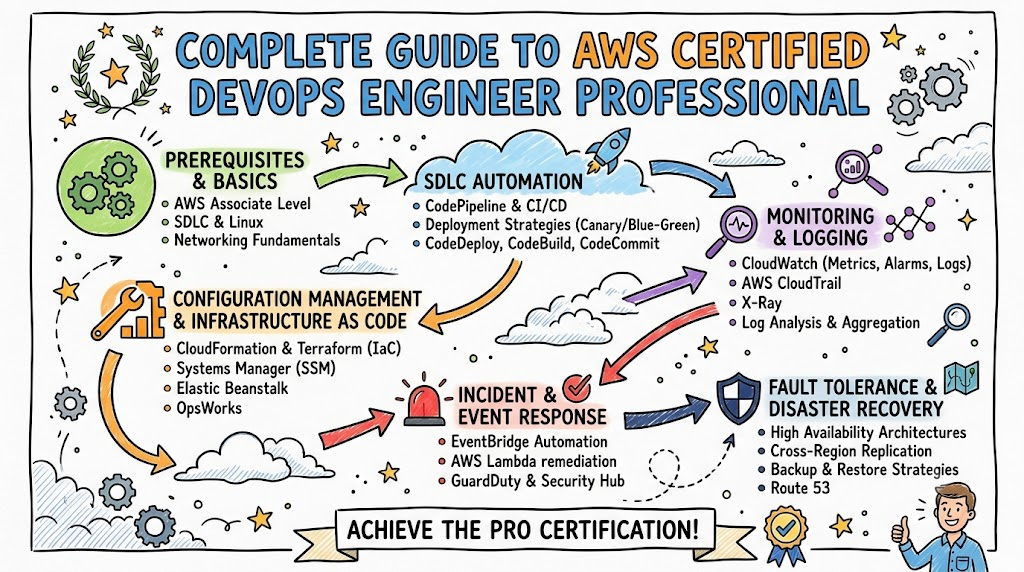
The structured program is delivered via the official training track and hosted on DevOpsSchool. The assessment evaluates six core domains: SDLC automation, configuration management and infrastructure as code, resilient cloud environments, monitoring and logging, incident and event response, and security and compliance.The certification demands professional-tier competence, evaluating scenarios requiring cross-service automation, complex error recovery, and enterprise multi-account setups. Rather than asking single-service questions, the examination presents multi-layered problems that assess an engineer's capability to balance trade-offs among availability, security, complexity, and operational efficiency.
Why Chose DevOpsSchool
DevOpsSchool has established itself as an authoritative global training platform delivering practical, hands-on enterprise technical education. The platform focuses on production-readiness by pairing industry practitioners with students in rigorous lab environments. Rather than teaching isolated theory, training modules incorporate real production scenarios, complex infrastructure code, and operational failure drills.DevOpsSchool emphasizes real-world tools, multi-cloud patterns, container orchestration, and automated pipelines, giving candidates deep practical context beyond the standard exam syllabus. Participants gain lifetime access to continuously updated courseware, active community support forums, guided interview preparation sessions, and hands-on real-time project implementations. These comprehensive resources make DevOpsSchool a reliable enabler for professionals aiming to pass rigorous technical certifications while elevating their daily engineering output.
AWS Certified DevOps Engineer Professional Certification Tracks & Levels
The AWS certification ecosystem organizes credentials into four tiers: Foundational, Associate, Professional, and Specialty. Foundational credentials cover broad cloud literacy, while Associate certifications confirm intermediate architectural, administrative, or software development competencies. The Professional tier serves as the benchmark for comprehensive architectural and operational mastery.The AWS Certified DevOps Engineer Professional operates at this advanced level, functioning as the capstone for cloud delivery workflows. It unifies the development competencies validated in Associate exams with the high-availability governance patterns emphasized in enterprise infrastructure tracks. This level establishes the technical baseline required for specialized roles across DevOps, DevSecOps, SRE, and platform engineering disciplines.
Complete AWS Certified DevOps Engineer Professional Certification Table
| Track | Level | Who it’s for | Prerequisites | Skills Covered | Recommended Order |
|---|---|---|---|---|---|
| DevOps Engineering | Professional | Senior DevOps, Cloud Engineers, SREs | Associate Cloud Knowledge, 2+ Years Production Cloud Exposure | CI/CD, IaC, Automated Remediation, Blue/Green Deployments | 2 (After Associate) |
| Cloud Operations | Associate | Systems Administrators, Operations Support | Basic Operating Systems, Scripting, Cloud Core | CloudWatch, Systems Manager, Patching, Auto Scaling | 1 (Foundation Step) |
| Cloud Development | Associate | Software Developers, Systems Programmers | Core Programming, API Design, Microservices | Serverless, SDKs, Messaging, IAM Security Policies | 1 (Foundation Step) |
| Platform Engineering | Professional | Principal Engineers, Technical Architects | Broad Systems Architecture, Security Foundations | Multi-Account Management, Organizations, SCPs, CDK | 3 (Advanced Specialization) |
Detailed Guide for Each AWS Certified DevOps Engineer Professional Certification
AWS Certified DevOps Engineer Professional – AWS Certified DevOps Engineer Professional
What it is
This credential validates an engineer's advanced technical ability to provision, operate, secure, and manage distributed application systems on the Amazon Web Services cloud platform. It verifies professional competence in designing robust CI/CD pipelines, automating configuration management, and orchestrating resilient, self-healing production environments.
Who should take it
This certification is built for senior DevOps engineers, site reliability engineers, systems architects, and platform developers who possess two or more years of hands-on experience provisioning and operating AWS environments. It is suited for professionals tasked with reducing deployment friction, managing compliance, and improving overall system resilience.
Skills you’ll gain
- Designing and implementing multi-account CI/CD pipelines using AWS CodePipeline, CodeBuild, and CodeDeploy
- Writing reusable, modular Infrastructure as Code using AWS CloudFormation, CDK, and nested stack architectures
- Managing fleet configuration, patching, and compliance automation using AWS Systems Manager, Config, and EventBridge
- Implementing safe deployment patterns including canary releases, blue/green cutovers, and automated health check rollbacks
- Architecting centralized logging, tracing, and operational telemetry using Amazon CloudWatch, CloudTrail, OpenSearch, and AWS X-Ray
- Enforcing automated security governance and identity boundaries with Service Control Policies (SCPs) and IAM role federation
Real-world projects you should be able to do
- Implement an automated enterprise multi-region deployment pipeline with automated rollbacks driven by CloudWatch metric anomalies.
- Design a centralized compliance monitoring framework using AWS Config Rules, EventBridge event routing, and Systems Manager Automation runbooks to auto-remediate non-compliant resources.
- Build an immutable containerized delivery architecture utilizing Amazon ECS or EKS with CodePipeline, complete with automated container vulnerability scanning.
- Create a multi-account log aggregation architecture forwarding CloudTrail, VPC Flow Logs, and application traces into a secure logging account with OpenSearch visualization.
Preparation plan
- 7–14 Days Plan: Review the official exam guide, focus on high-frequency domain gaps, take full-length scenario-based practice tests, and review detailed answer explanations for cross-account IAM and deployment patterns.
- 30 Days Plan: Spend week one covering CI/CD and deployment strategies; week two reviewing Infrastructure as Code and multi-account governance; week three practicing automated remediation, monitoring, and logging architectures; and week four running intensive exam simulations.
- 60 Days Plan: Dedicate weeks one through three to building real hands-on lab projects in a dedicated multi-account sandbox; weeks four and five to studying enterprise whitepapers and architectural patterns; and the final three weeks to mock exams, gap analysis, and time-management drills.
Common mistakes
- Relying exclusively on high-level theory without writing hands-on CloudFormation templates, CDK code, or buildspec definitions.
- Overlooking nuances in multi-account deployments, including cross-account role assumption, S3 bucket policies, and KMS key delegations.
- Confusing various deployment mechanics, such as linear traffic shifting versus canary releases via AWS CodeDeploy.
- Ignoring incident response automation and event patterns connecting EventBridge, Systems Manager Automation, and Lambda functions.
Best next certification after this
- Same-track option: AWS Certified Solutions Architect Professional for complete architectural governance and complex enterprise system design.
- Cross-track option: Certified Kubernetes Administrator (CKA) or AWS Certified Security Specialty to expand container orchestration and security capabilities.
- Leadership option: Certified Information Systems Security Officer (CISSO) or ITIL Strategic Leader to support engineering management and technical leadership roles.
Choose Your Learning Path
DevOps Path
The core DevOps track emphasizes rapid, reliable software delivery using continuous integration, continuous deployment, and automated infrastructure testing. Engineers mastering this path focus on eliminating manual delivery friction, creating immutable deployment patterns, and enforcing configuration version control. This learning track forms the technical backbone of modern cloud engineering teams worldwide.
DevSecOps Path
The DevSecOps pathway integrates automated security controls, continuous compliance scanning, and vulnerability detection directly into active CI/CD pipelines. Practitioners learn to embed static analysis, dynamic security testing, secret management, and automated policy verification without slowing down release cycles. This path is essential for engineers working within highly regulated sectors such as fintech, healthcare, and enterprise software.
SRE Path
The Site Reliability Engineering track shifts focus toward availability, latency, incident response, and performance monitoring. Engineers on this journey master Service Level Objectives (SLOs), error budgeting, automated disaster recovery, and production health observability. It equips candidates with the diagnostic mindset needed to run complex distributed applications with high reliability.
AIOps Path
The AIOps path focuses on applying machine learning, algorithmic event correlation, and anomaly detection to massive volumes of operational telemetry. Engineers learn to automate root-cause analysis, reduce alert fatigue, and predict infrastructure bottlenecks before customer impact occurs. This track prepares infrastructure professionals to lead intelligent observability transformations across modern cloud footprints.
MLOps Path
The MLOps trajectory addresses the operational lifecycle of machine learning models from data pipeline orchestration to continuous training, evaluation, and production serving. Professionals develop production workflows that combine continuous deployment with automated data validation, model drift monitoring, and scalable distributed compute. This specialization bridges data science innovation with stable engineering operations.
DataOps Path
The DataOps track focuses on delivering quality, automated, and continuous delivery for enterprise data pipelines and analytical platforms. Engineers learn to implement automated testing for data ingestion, version data models, manage distributed transformations, and monitor pipeline health. This path is vital for teams managing distributed data lakes, operational warehousing, and real-time streaming architectures.
FinOps Path
The FinOps journey unites engineering workflows with cloud financial accountability, unit economics, and continuous resource optimization. Candidates develop skills to implement automated cost attribution, rightsizing policies, savings plan modeling, and automated non-production resource scheduling. This path ensures technical architectures align directly with organizational business efficiency and operational value.
Role → Recommended AWS Certified DevOps Engineer Professional Certifications
| Role | Recommended Certifications |
|---|---|
| DevOps Engineer | AWS Certified DevOps Engineer Professional, Certified Kubernetes Administrator (CKA) |
| SRE | AWS Certified DevOps Engineer Professional, AWS Certified Solutions Architect Professional |
| Platform Engineer | AWS Certified DevOps Engineer Professional, HashiCorp Certified Terraform Associate |
| Cloud Engineer | AWS Certified SysOps Administrator Associate, AWS Certified DevOps Engineer Professional |
| Security Engineer | AWS Certified DevOps Engineer Professional, AWS Certified Security Specialty |
| Data Engineer | AWS Certified DevOps Engineer Professional, AWS Certified Data Engineer Associate |
| FinOps Practitioner | AWS Certified DevOps Engineer Professional, FinOps Certified Practitioner (FOCP) |
| Engineering Manager | AWS Certified DevOps Engineer Professional, AWS Certified Cloud Practitioner |
Next Certifications to Take After AWS Certified DevOps Engineer Professional
Same Track Progression
After mastering the professional DevOps examination, technical specialists should target the AWS Certified Solutions Architect Professional. This progression broadens your horizon from continuous deployment workflows to wide-ranging enterprise infrastructure design, complex network routing, and multi-region disaster recovery topologies. It solidifies your identity as a principal cloud engineer capable of solving high-stakes architectural challenges.
Cross-Track Expansion
To remain versatile across diverse enterprise technology stacks, expanding cross-track into container orchestration is highly recommended. Achieving the Certified Kubernetes Administrator (CKA) or pursuing the AWS Certified Security Specialty enables you to manage microservices at scale and secure complex infrastructure footprints against sophisticated threats. These cross-disciplinary capabilities are sought after by high-growth platform engineering teams.
Leadership & Management Track
For experienced engineers seeking a move into engineering management, director, or enterprise architect positions, transitioning toward governance and strategic leadership frameworks is critical. Credentials such as ITIL Strategic Leader, TOGAF Enterprise Architecture certification, or certified agile leadership programs complement your deep technical pedigree. This prepares you to lead large engineering organizations, manage capital expenditure, and set technology roadmaps.
Training & Certification Support Providers for AWS Certified DevOps Engineer Professional
DevOpsSchool is a prominent training and consulting organization delivering comprehensive certification programs, real-time enterprise labs, and professional career mentorship across cloud, automation, and platform engineering disciplines.Cotocus provides dedicated enterprise IT enablement, hands-on architectural advisory, and technical workforce training designed to accelerate organizational cloud migration and continuous delivery adoption.SREMind delivers specialized learning tracks centered around site reliability engineering practices, chaos engineering frameworks, operational telemetry, and resilient production management for modern engineers.ScrHut provides structured technical content, learning repositories, and focused certification support modules engineered to assist technical candidates with targeted skill development.
The Core Platform Authority
DevOpsSchool has built a proven track record as an industry-leading training platform dedicated to upskilling professionals across DevOps, cloud automation, Site Reliability Engineering, and modern enterprise architecture. The platform distinguishes itself through its strong emphasis on hands-on, production-grade learning led by seasoned industry practitioners with decades of active field experience. Rather than focusing strictly on theoretical exam criteria, DevOpsSchool immerses learners in realistic enterprise scenarios, complete with real-time incident simulations, scalable infrastructure as code workflows, and end-to-end continuous integration and deployment pipelines. With lifetime access to learning resources, comprehensive interview preparation, dedicated mentorship support, and continuously updated course materials aligned with evolving industry standards, DevOpsSchool empowers aspiring engineers, senior technical specialists, and engineering managers globally to validate their expertise, achieve prestigious professional certifications, and drive measurable technical innovation within their organizations.
Frequently Asked Questions (General)
- How difficult is the professional-tier DevOps certification compared to associate-level exams?
The professional certification is considerably more difficult than associate tests because it requires analyzing complex, multi-layered real-world scenarios rather than recalling individual service features.
- How much time should a working engineer spend preparing for this exam?
Most engineers with prior cloud experience require between four and eight weeks of consistent daily study, dedicating roughly ten to fifteen hours per week.
- Are there mandatory formal prerequisites before attempting this certification?
AWS no longer requires candidates to hold an Associate certification prior to attempting the Professional exam, though having that foundational experience is strongly advised.
- What is the standard validity period for this professional credential?
The certification remains valid for three years from the date you pass the examination, after which you must recertify to maintain your active status.
- Does this certification focus exclusively on AWS native tools?
While primarily centered on AWS native services such as CodePipeline and CloudFormation, questions frequently address integration with external systems, hybrid environments, and third-party tooling.
- Can I clear the exam using theoretical study and video courses alone?
Clearing this examination without extensive hands-on lab practice is extremely difficult because questions evaluate subtle nuances in configuration and automated remediation logic.
- How does holding this credential impact salary and career opportunities?
Professional-tier certified cloud engineers consistently command higher market salaries, stand out during resume screenings, and gain faster access to senior and principal roles.
- Is the exam administered in an online environment or at test centers?
Candidates can choose between taking a proctored online examination from a quiet home or office setting, or sitting for the test in person at an authorized testing center.
- What is the overall passing score and question format?
The passing scaled score is 750 on a range from 100 to 1000, consisting of multiple-choice and multiple-response questions distributed across 180 minutes.
- Should software developers take this certification, or is it strictly for operations engineers?
Software developers building cloud-native microservices will gain immense value, as it clarifies release automation, container hosting, secret management, and distributed tracing.
- How frequently does AWS update the exam syllabus and domain weightings?
AWS periodically updates exam blueprints, moving from older versions to newer iterations (such as DOP-C02) to reflect contemporary architectural trends and retired features.
- What role do official practice exams play during final preparation?
Official timed practice tests are critical for identifying knowledge gaps, evaluating pacing under pressure, and becoming comfortable with lengthy scenario descriptions.
FAQs on AWS Certified DevOps Engineer Professional
- What primary topics dominate the SDLC automation domain in this exam?
The SDLC domain heavily tests the design of multi-stage pipelines using CodePipeline, custom container build environments in CodeBuild, and complex deployment topologies in CodeDeploy. You are expected to know how to set up automated gates, inject dynamic parameters from parameter stores, handle secure artifact management, and execute seamless rollbacks based on operational alarms.
- How are configuration management and infrastructure as code evaluated?
This area assesses your depth in AWS CloudFormation, the Cloud Development Kit (CDK), and AWS Systems Manager. You must understand stack sets across multiple accounts and regions, drift detection mechanics, custom resources, nested stacks, and automated configuration compliance to pass these complex scenario questions.
- Which deployment strategies should a candidate master for the exam?
Candidates must understand blue/green, rolling, linear, and canary deployment patterns across instance fleets, container clusters (ECS and EKS), and serverless architectures. You must know how to route DNS traffic with Route 53, configure Application Load Balancer target groups, and automate health monitoring to trigger safe rollbacks.
- How prominent are multi-account and multi-region architectures?
Multi-account strategies appear throughout almost every exam domain. You must understand AWS Organizations, Service Control Policies, cross-account IAM role assumption, centralized CloudTrail aggregation, and transit network topologies to answer operational and deployment scenarios correctly.
- What event-driven automation techniques are tested on this examination?
The exam tests your ability to react to system state changes using Amazon EventBridge rules, AWS Config auto-remediation workflows, Systems Manager Automation runbooks, and Lambda invocation. You must be able to design architectures that automatically remediate unauthorized security group changes or instance non-compliance.
- What observability tools must an engineer know thoroughly?
You must have deep familiarity with Amazon CloudWatch metrics, alarms, logs insights, metric filters, and dashboards, alongside AWS X-Ray for distributed trace analysis. Understanding how to aggregate, filter, and ship application logs securely across accounts is essential for passing the monitoring domain.
- How does the exam evaluate security, secrets, and compliance?
The test evaluates continuous compliance using AWS Config, automated image inspection via Amazon Inspector, secret rotation using Secrets Manager, and fine-grained access control using IAM and KMS. You must understand how to secure pipeline stages without exposing plain-text credentials.
- How does container orchestration factor into this certification?
The exam assesses deployment patterns, container security scanning, and pipeline integration for Amazon ECS and EKS workloads. You should understand task definitions, service autoscaling, blue/green cutovers with CodeDeploy, and how to build efficient, secure container images in automated pipelines.
Final Thoughts: Is AWS Certified DevOps Engineer Professional Worth It?
Achieving the AWS Certified DevOps Engineer Professional certification requires substantial dedication, disciplined hands-on practice, and a willingness to dissect complex systems failure modes. It is not an entry-level stepping stone or a credential you can obtain by memorizing theoretical definitions. The exam challenges you to think like an engineer responsible for critical infrastructure, demanding balanced choices between deployment speed, system reliability, security boundaries, and operational overhead.If you work daily with cloud platforms, or if your organization is modernizing legacy architectures into containerized, automated delivery workflows, the preparation journey will fundamentally sharpen how you design and troubleshoot production systems. The credential validates to colleagues, leadership, and prospective employers that you can take end-to-end responsibility for enterprise applications under real-world conditions. Approach your studies as a comprehensive operational upgrade, build real lab environments, test your failure scenarios thoroughly, and let the resulting competence guide your engineering career forward.
